
AI-Powered Insurance Policy Review: Everything You Need to Know in 2026
Insurance policy review is one of the most document-intensive, accuracy-critical processes in the industry. A single commercial policy can run to hundreds of pages. A single missed exclusion clause, a misread coverage limit, or an inconsistency between policy versions can translate directly into claim disputes, compliance violations, or financial exposure.
AI insurance policy review software is changing this. Where manual review takes hours and introduces inconsistency, AI policy analysis extracts, validates, and reports on policy documents in minutes at consistent accuracy, at any volume, without the bottlenecks that manual processes create.
This guide covers everything you need to know about AI-powered insurance policy review in 2026 how it works, what it delivers, which features matter, and how to choose the right solution for your insurance operation.
What Is an AI Insurance Policy Reviewer?
An AI insurance policy reviewer is an intelligent software system that reads, analyses, and interprets insurance policy documents automatically replacing the manual process of having an underwriter, compliance officer, or policy administrator review documents line by line.
Unlike basic document management tools, an AI policy reviewer understands policy language it can identify specific clause types, detect missing provisions, flag inconsistencies, compare versions, and generate structured review reports with actionable recommendations.
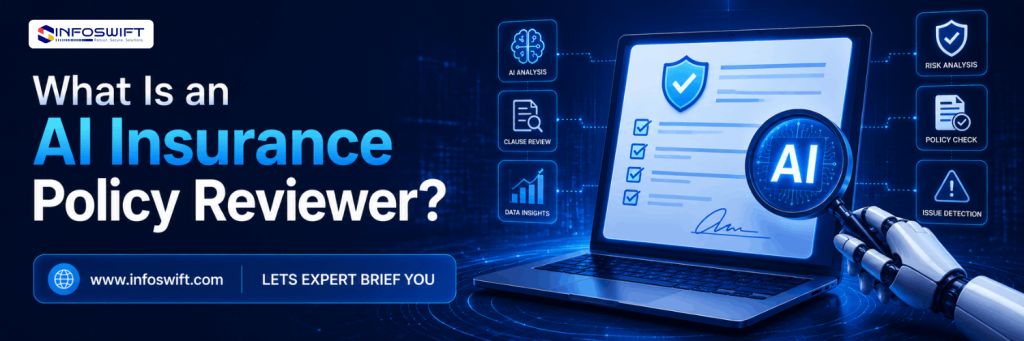
How AI reads insurance documents:
- NLP and machine learning: Natural language processing models trained on insurance-specific policy language understand the semantic meaning of clauses not just the words. Machine learning identifies patterns across thousands of policy documents to recognise what a coverage limit looks like, what an exclusion clause signals, and when something that should be present is missing.
- OCR for scanned PDFs: Optical Character Recognition converts scanned or image-based policy documents into machine-readable text before analysis begins. Modern AI policy review software handles low-resolution scans, mixed print and handwritten annotations, and multi-column layouts without manual pre-processing.
- Real-time policy interpretation: Once text is extracted and classified, the AI interprets policy provisions in real time cross-referencing coverage terms against compliance requirements, comparing clauses against standard policy templates, and surfacing anomalies that require human attention.
How AI Policy Analysis Works
AI policy analysis follows a structured, automated workflow from document upload to review report. Each stage adds a layer of intelligence that manual review cannot replicate at the same speed or consistency.
- Upload policy: The user uploads a policy document in any format — native PDF, scanned PDF, Word document, or image file. The system accepts multi-page, multi-section documents without formatting constraints.
- AI extracts data: OCR converts image-based content to text. NLP then identifies and classifies every provision — coverage terms, exclusion clauses, definitions, endorsements, sub-limits, and conditions — into a structured data schema.
- Detects missing information: The AI checks extracted content against expected policy structure for that policy type and line of business. Missing mandatory clauses, absent definitions, or incomplete coverage sections are flagged automatically.
- Compares clauses: Where multiple policy versions or a comparison policy exist, the AI performs a clause-by-clause comparison identifying additions, deletions, and modifications between versions and highlighting material differences.
- Highlights risks: The system identifies exclusions that may create coverage gaps, sub-limits that may fall below regulatory minimums, contradictory provisions within the same policy, and language that deviates from standard clause libraries.
- Generates review report: A structured report is produced containing: extracted policy data, detected issues with severity ratings, compliance status, recommended actions, and a complete audit trail. Delivered in minutes. Ready for underwriter review or client delivery.
Common Challenges with Manual Policy Review
Understanding why manual policy review fails at scale explains why AI policy review software has become a priority investment for forward-thinking insurance operations.
Human errors: A reviewer reading a 200-page commercial policy across multiple sessions will miss things. Fatigue, distraction, and the sheer cognitive load of complex policy language introduce errors that manual quality control processes catch inconsistently.
- Slow turnaround: Manual policy review takes hours per document at minimum. For high-volume operations renewal seasons, bulk submissions, compliance audits this creates processing backlogs that delay underwriting, frustrate brokers, and slow claims.
- Compliance risks: Regulatory requirements change. A manual review process dependent on individual reviewer knowledge introduces compliance risk every time a regulation updates, a new product is launched, or a policy template is revised.
- Large document volumes: Insurance operations receive thousands of policies. At peak periods quarter-end, renewal cycles, catastrophe events the volume exceeds what manual teams can process without overtime, outsourcing, or backlogs.
- Inconsistent reviews: Two reviewers reading the same policy will produce different findings. Inconsistency in review standards creates liability, undermines audit readiness, and produces uneven customer experiences across the same product line.
- High operational costs: Manual policy review is staff-intensive. The fully-loaded cost salary, benefits, management overhead, error correction, and rework makes it one of the highest per-document processing costs in insurance operations.
Benefits of AI Insurance Policy Review Software
The shift from manual to AI policy review software is measurable at every stage of the policy lifecycle. The comparison below reflects outcomes from production deployments across insurance carriers, MGAs, and policy administration teams.
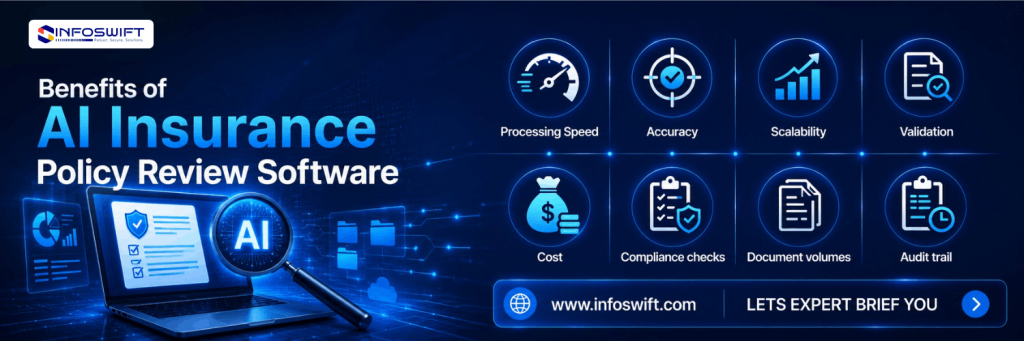
Factor | Manual Policy Review | AI Policy Review |
Processing Speed | Hours to days | Minutes |
Accuracy | Human error-prone | High accuracy, consistent |
Scalability | Limited by headcount | Unlimited, on-demand |
Validation | Manual, inconsistent | Automated, rule-based |
Cost | High operational cost | Cost-effective at scale |
Compliance checks | Manual tracking | Real-time automated checks |
Document volumes | Bottleneck at peak | No volume ceiling |
Audit trail | Inconsistent documentation | Full automated audit trail |
Key benefits in practice:
- Faster underwriting: Policy data extracted and validated in minutes rather than hours means underwriting teams receive accurate, structured submissions faster reducing time-to-quote and improving broker relationships.
- Higher accuracy: AI policy analysis applies the same review logic to every document, every time. Accuracy rates above 95% on policy data extraction eliminate the inconsistency and error rate of manual review.
- Automated compliance checks: Regulatory requirements are encoded into the AI review engine. Every policy is checked against current compliance standards automatically without relying on individual reviewer knowledge or manual tracking.
- Better customer experience: Faster policy review means faster policy issuance, faster claims decisions, and more responsive broker service. Policyholders notice turnaround time.
- Reduced operational costs: Automating document-intensive review tasks reduces the direct cost per policy processed and reallocates skilled underwriters and compliance officers to higher-value decisions.
- Consistent decision making: Every policy reviewed by AI follows the same review logic, the same clause library, and the same compliance rules producing consistent, auditable, and defensible outcomes across the entire book.
Key Features of AI Policy Review Software
Not all AI policy review tools are equivalent. The following features define a production-ready AI insurance policy review software capable of handling enterprise insurance operations.
Document Upload — PDF, Word, and Images: A capable AI policy reviewer accepts any document format without pre-processing requirements. Native PDFs, scanned PDF images, Word documents, TIFF, JPEG, and multi-page composites must all be ingested without manual conversion. Support for batch upload at volume is essential for renewal processing and portfolio audits.
OCR and Text Extraction: OCR capability determines whether the system can handle the real-world document mix in insurance which includes low-resolution scans, faxed documents, and handwritten annotations. The best AI policy review software uses advanced ICR (Intelligent Character Recognition) to handle degraded documents that basic OCR misreads.
AI Policy Analysis: AI policy analysis goes beyond text extraction. The NLP engine must understand insurance policy language recognising clause types, interpreting conditional provisions, and understanding the relationship between endorsements and base policy terms. Domain-specific training on insurance documents is non-negotiable for production accuracy.
Risk Detection: The system must proactively identify not just extract risks within the policy. This includes exclusions that create coverage gaps, sub-limits that fall below minimums, contradictory provisions, missing mandatory clauses, and language that deviates from standard policy forms. Risk findings should be severity-rated and actionable.
Policy Comparison: For renewals, endorsements, and version control, the AI must perform clause-by-clause comparison between policy versions identifying additions, deletions, coverage changes, and premium-affecting modifications. Side-by-side comparison reports should be generated automatically.
Compliance Validation: Policy review automation must include automated compliance validation against regulatory requirements relevant to the policy type, jurisdiction, and line of business. Compliance rules must be updatable as regulations change without requiring system redevelopment.
Smart Recommendations: Beyond identifying issues, the AI should generate specific, actionable recommendations suggested clause language, missing provision templates, coverage adjustment recommendations, and escalation flags for human review. Recommendations should be ranked by risk severity and business impact.
Policy Management Dashboard: A centralised policy management dashboard gives operations teams visibility across the entire policy portfolio track review status, search by policy number or insured name, filter by issue type or compliance status, store document versions, and monitor renewal alerts. Integration with existing policy administration systems via API is standard in enterprise deployments.
Use Cases Across Insurance Lines
AI insurance policy review software is applicable across every line of business. The specific extraction fields and compliance rules vary by policy type but the core workflow is consistent: upload, extract, analyse, detect, report.
|
🚗 Auto Insurance |
🏠 Home Insurance |
🏥 Health Insurance |
🏢 Commercial Insurance |
💼 Life Insurance |
|
Review coverage limits, liability clauses, and deductible terms. Flag inconsistencies across policy versions. |
Validate property coverage scope, exclusions, and replacement value accuracy against regulatory standards. |
Verify benefits, pre-existing condition clauses, network limitations, and claim eligibility criteria. |
Evaluate risk exposure, business interruption terms, liability limits, and multi-location coverage gaps. |
Check policy clause accuracy, beneficiary terms, exclusion language, and surrender value calculations. |
For each line, the AI can be trained on the specific policy forms, standard clause libraries, and regulatory requirements relevant to that product and jurisdiction producing line-of-business-specific accuracy that generic document tools cannot match.
AI Policy Review Automation in Insurance Workflows
Policy review automation does not exist in isolation it connects to and accelerates every major workflow in the insurance operation. Here is where AI fits across the full insurance value chain.
- Quote generation: AI extracts and validates key policy parameters from incoming submissions, ensuring underwriters receive structured, verified data for quote generation rather than raw document packages requiring manual review.
- Underwriting: AI policy analysis surfaces risk signals, coverage gaps, and compliance issues at submission stage enabling underwriters to focus on risk judgment rather than document review. Submission-to-quote time drops significantly.
- Claims processing: At first notice of loss, the AI retrieves the relevant policy, extracts coverage terms applicable to the claim type, and verifies claim eligibility against policy provisions automatically, before an adjuster reviews the file.
- Renewals: AI compares the renewing policy against the expiring policy, identifies coverage changes, premium-affecting modifications, and exclusion additions, and generates a renewal review report for underwriter or broker delivery.
- Compliance audits: AI reviews the entire in-force portfolio against current regulatory standards automatically surfacing non-compliant policies, identifying remediation requirements, and generating audit-ready documentation.
- Broker operations: Brokers use AI policy review software to validate policies on behalf of clients, compare competing coverage options, and generate client-ready coverage summaries without manual reading of full policy documents.
How AI Improves Policy Management
Beyond individual policy review, AI transforms policy management at the portfolio level creating a searchable, version-controlled, compliance-monitored document environment that manual systems cannot replicate.
- Centralised document storage: All policy documents stored in a single, secure, searchable repository. No more documents scattered across shared drives, email attachments, and desk drawers. Every policy version accessible to authorised users from any location.
- Version control: Every policy update, endorsement, and renewal is tracked as a distinct version with a full audit trail. Differences between versions are automatically surfaced eliminating the risk of working from an outdated policy document.
- Automatic indexing: AI extracts and indexes key policy attributes insured name, policy number, effective dates, coverage types, sub-limits, exclusions making every policy searchable by any attribute without manual tagging.
- Searchable policies: Full-text and attribute-based search across the entire policy portfolio. Find every policy with a specific exclusion clause, every policy expiring in the next 30 days, or every policy covering a specific risk type in seconds.
- Alerts for renewals: Automated renewal alerts triggered by policy expiry dates extracted during the initial AI review. No manual tracking required. Notifications routed to the relevant underwriter, broker, or account manager automatically.
- Compliance tracking: Ongoing compliance monitoring across the in-force portfolio. When regulations change, the AI re-reviews affected policies against updated requirements and surfaces non-compliant documents for remediation proactively, not during an audit.
Choosing the Right AI Insurance Policy Review Software
Not every AI policy review software is built for enterprise insurance requirements. Use this checklist when evaluating vendors every item is a production requirement, not a nice-to-have.
Vendor Evaluation Checklist
✔ OCR support — handles scanned PDFs, low-resolution images, and mixed-format documents without manual pre-processing.
✔ NLP engine — trained on insurance-specific policy language, not generic text models.
✔ Custom AI models — ability to train on your specific policy forms, clause libraries, and product types.
✔ API integrations — connects to your policy administration, underwriting, CRM, and claims systems.
✔ Cloud deployment — scalable cloud infrastructure with no hardware overhead and enterprise SLAs.
✔ Security — data encryption at rest and in transit, role-based access control, full audit logging.
✔ Compliance — regulatory requirements configurable by jurisdiction, line of business, and policy type.
✔ Dashboard and reporting — policy management dashboard with search, filtering, version control, and reporting.
✔ Workflow automation — configurable review workflows, approval routing, alert triggers, and escalation logic.
✔ Scalability — no volume ceiling on document processing; pricing that scales with usage, not per-user licences.
Why Choose InfoSwift for AI Insurance Policy Review Solutions
InfoSwift is an enterprise AI and digital transformation technology partner specialising in AI insurance software for carriers, MGAs, policy administration teams, and brokers. We do not sell generic document tools we build custom AI insurance policy review software designed for your specific policy types, compliance requirements, and operational workflows.
Our insurance AI engineering team brings deep domain expertise in policy language, regulatory frameworks, and insurance workflow design combined with production-grade AI development capability in NLP, OCR, machine learning, and cloud architecture.
|
InfoSwift Capability |
What It Delivers |
|
Custom AI Policy Reviewer |
Built and trained on your insurance document types |
|
AI Document Parser |
Extracts structured data from PDFs, scanned images, and Word files |
|
Intelligent Policy Analysis |
NLP-powered clause review, risk detection, and gap analysis |
|
Policy Review Automation |
End-to-end workflow automation from upload to review report |
|
OCR + NLP Integration |
Handles any document format digital or scanned |
|
Cloud-Based AI Solutions |
Scalable, secure cloud deployment with zero infrastructure overhead |
|
API Integrations |
Connects to your existing CMS, CRM, underwriting, and claims systems |
|
Secure Enterprise Deployment |
SOC 2-aligned security, data encryption, role-based access |
|
Workflow Automation |
Automated routing, alerts, approval workflows, and audit logging |
|
Ongoing Support & Maintenance |
Dedicated team for model retraining, updates, and performance monitoring |
InfoSwift AI policy review solutions are currently deployed across insurance operations handling auto, home, commercial, health, and life policies processing millions of policy documents annually with measurable improvements in review speed, accuracy, and compliance coverage.
Frequently Asked Questions About AI Insurance Policy Reviewer Software
An AI insurance policy reviewer is software that reads, analyses, and interprets insurance policy documents automatically using NLP and machine learning. It extracts policy data, detects missing provisions, flags compliance issues, compares policy versions, and generates structured review reports — replacing hours of manual document review with minutes of automated analysis.
AI policy analysis follows six steps: document upload, OCR text extraction, NLP-powered clause classification and data extraction, missing information detection, risk and compliance flagging, and report generation. The entire workflow runs automatically from upload to review report — no manual data entry at any stage.
Yes. AI policy review software trained on insurance-specific policy language consistently achieves extraction accuracy above 95% on well-represented policy types. Domain-specific training on your policy forms and clause libraries improves accuracy further. Low-confidence extractions are flagged for human review — ensuring accuracy where it matters most.
Faster processing (hours to minutes), higher accuracy than manual review, automated compliance validation, consistent review standards across the entire book, reduced operational cost per policy, and full audit trail documentation. For high-volume operations, AI policy review eliminates seasonal backlogs and scales without headcount increases.
Enterprise AI policy review software operates with data encryption in transit and at rest, role-based access control, full audit logging, and configurable data residency. InfoSwift deployments are SOC 2-aligned. Policy documents never leave your secure environment without explicit authorisation.
Yes. AI insurance policy review software connects to policy administration systems, underwriting platforms, CRM, document management systems, and claims platforms via API. InfoSwift provides pre-built connectors for common insurance platforms and custom API development for proprietary systems — no rip-and-replace required.
AI policy analysis handles auto, home, commercial, health, life, and specialty lines. The AI model is trained on the specific policy forms, standard clause libraries, and regulatory requirements for each line of business and jurisdiction. Custom training ensures line-of-business-specific accuracy across your entire product portfolio.
AI transforms policy management by creating centralised, searchable, version-controlled document storage with automatic indexing of all key policy attributes. Renewal alerts, compliance tracking, and portfolio-level reporting are automated — giving operations teams real-time visibility across the entire in-force book without manual tracking.