End-to-End Digital Transformation Solutions for Growing Businesses
KEY TAKEAWAYS |
|
|
|
|
|
|
Every growing business reaches a point where the tools that got it here are no longer sufficient for where it needs to go. Customer expectations have risen. Competitors are moving faster. The manual processes that were manageable at twenty employees are breaking at a hundred. The systems that handled the business at one location are straining across three.
This is the inflection point that digital transformation solutions are designed to address. Not as a technology upgrade, but as a fundamental rethinking of how the business operates, serves customers, and makes decisions. This guide explains what digital transformation actually means, why growing businesses need it, what it involves, and how a structured approach produces results without the chaos of doing too much at once.
What Is Digital Transformation?
Digital transformation is the process of integrating digital technology across all areas of a business to fundamentally change how it operates and delivers value to customers. It is not the same as buying new software or moving files to the cloud. Those are components. Transformation is what happens when technology changes the underlying model of how the business works.
The distinction matters because businesses frequently invest in digital tools without transforming. They add a CRM without redesigning the sales process. They migrate to cloud infrastructure without rethinking how applications are architected. They adopt automation without addressing the workflow it is supposed to improve. The result is modern technology running inefficient processes, which produces limited returns on a significant investment.
True business digital transformation requires three things to be true simultaneously: the technology must be appropriate for the problem, the processes must be redesigned to take advantage of the technology, and the people must have the capability and context to operate in the new way.
Digital Transformation vs Digitalization vs Digitization
These three terms are used interchangeably and incorrectly almost everywhere. The distinctions are meaningful and have direct implications for what a business actually needs to invest in.
Digitization | Digitalization | Digital Transformation |
Converting paper records and analogue information into digital format. A process, not a strategy. | Using digital data and tools to improve and automate existing business processes. Efficiency-focused. | Fundamentally reimagining how a business creates value, serves customers, and operates enabled by technology. |
Example: scanning invoices into a PDF instead of filing paper copies. | Example: using invoice scanning software to auto-populate your accounting system. | Example: replacing the entire invoice process with an AI-powered accounts payable system that needs no human intervention. |
Most businesses that think they have done digital transformation have actually done digitalization at best. The gap between digitalization and genuine transformation is where competitive advantage is created or lost.
Why Growing Businesses Need Digital Transformation Solutions
The pressure to transform is not abstract for growing businesses. It shows up as specific, recognisable operational problems that compound as the business scales. Each of the following is both a symptom of under-transformation and a driver of the cost and competitive risk of delaying it.
- Manual workflows. Manual workflows that were manageable at ten employees become unsustainable at fifty. The staff hours consumed by data entry, report generation, approval chains, and process handoffs grow proportionally with the business unless they are automated. Growing businesses that do not address this find their headcount growing faster than their revenue.
- Legacy applications. Legacy applications that were deployed years ago carry the technical debt of every feature added, every workaround built, and every integration patched together over time. They are slow to update, expensive to maintain, and increasingly unable to integrate with modern tools. They also represent a security risk as vendor support ends.
- Disconnected systems. Disconnected systems produce the most common and most expensive data problem in mid-size businesses: the same information existing in multiple places in multiple forms, with no single version that can be trusted as authoritative. Finance has one customer record. Sales has a different one. Support has a third. Decisions get made on whichever version someone happens to access first.
- Data silos. Data silos prevent the cross-functional visibility that growing businesses need to make good decisions. When inventory data sits in a warehouse management system that does not talk to the sales platform, the business makes commitments it cannot keep and misses opportunities it cannot see.
- Increasing operational costs. Increasing operational costs follow directly from manual processes, legacy maintenance, and disconnected systems. The cost of maintaining fragmented technology infrastructure grows every year as the complexity compounds.
- Poor scalability. Poor scalability means that every new customer, new product, or new market the business enters requires proportionally more infrastructure, more headcount, or more custom development. Modern cloud-native architectures decouple capacity from cost, allowing businesses to scale without the capital expenditure that previously limited growth.
- Customer experience challenges. Customer experience challenges emerge when internal technology fragmentation becomes visible to the customer. Inconsistent information across channels, slow response times, and manual processes that introduce delays are all symptoms of under-transformation that customers notice and competitors exploit.
Key Components of End-to-End Digital Transformation
End-to-end digital transformation is not a single project. It is a coordinated programme of initiatives across multiple technology domains, sequenced to build on each other and deliver cumulative value. The following are the components that Infoswift delivers as part of a complete transformation engagement.
Custom Software Development
The foundation of most transformation programmes is software that is built for the specific business rather than adapted from generic tools. Custom software development creates the applications, platforms, and workflows that reflect how the business actually operates rather than forcing the business to conform to how a pre-built product works. For growing businesses, custom software eliminates the ceiling that generic SaaS tools impose on workflow complexity, integration capability, and business-specific logic.
Application Modernization
Most growing businesses are running at least one system that was built or purchased more than five years ago and has accumulated technical debt, integration workarounds, and performance limitations. Application modernization is the process of rebuilding or re-architecting these systems to meet current performance, integration, and security requirements without discarding the business logic they contain. Infoswift approaches modernization incrementally, using the strangler fig pattern where possible to reduce operational risk during the transition.
Cloud Transformation
Moving business applications and infrastructure to cloud platforms produces three distinct benefits: elasticity that allows capacity to scale with demand without capital expenditure, reduced infrastructure management overhead that frees technical teams for higher-value work, and access to cloud-native services in AI, analytics, and security that are expensive to replicate on-premise. Cloud transformation is not a lift-and-shift operation. Applications that are moved to cloud without being re-architected often cost more than the on-premise equivalent. Infoswift designs cloud architectures that are built to take advantage of cloud-native capabilities from the ground up.
Business Process Automation
Process automation converts manual, rule-based tasks into system-executed workflows. Approval chains, document routing, data entry, status notifications, report generation, and compliance checks are all candidates for automation. The business impact is direct: staff time redirected from routine processing to judgement-intensive work, error rates reduced by removing human handoffs from high-volume processes, and process cycle times shortened from days to minutes. Automation also creates the audit trails and process consistency that manual operations cannot guarantee.
AI-Powered Digital Transformation
Artificial intelligence adds a layer of intelligence to transformation that pure automation cannot provide. Where automation handles known processes with predictable outcomes, AI handles processes that involve pattern recognition, prediction, and decision support across large volumes of data. Document processing, demand forecasting, anomaly detection, customer behaviour modelling, and predictive maintenance are all AI applications that Infoswift integrates into transformation programmes. AI is most effective when it is designed into the transformation architecture from the beginning rather than added as a layer after deployment.
System and API Integration
Growing businesses typically run 10 to 50 separate software applications. Without integration, these applications produce data silos and require manual bridging between systems. System and API integration creates automated, reliable data exchange between applications so that a change in one system immediately propagates to all connected systems. Infoswift designs integration architectures using API gateways, event-driven patterns, and iPaaS platforms that are scalable, observable, and maintainable as the application landscape evolves.
Data Analytics and Business Intelligence
The data that transformation initiatives generate has no value unless it can be accessed, understood, and acted upon. Data analytics and business intelligence convert operational data into dashboards, reports, and models that give decision-makers real-time visibility into business performance. Infoswift builds BI platforms on top of transformed data infrastructure, connecting operational systems to analytics layers that surface the metrics each business function needs to make informed decisions.
Digital Transformation Roadmap for Growing Businesses
The most common reason digital transformation programmes fail is not a technology problem. It is a sequencing problem. Businesses deploy technology before processes are defined, invest in AI before data infrastructure is in place, or attempt to transform everything simultaneously and succeed at nothing. A structured digital transformation strategy prevents these failure modes by establishing a clear, sequenced path from current state to target state.
01 | Assess Existing Technology Before any investment decision is made, the current technology landscape must be documented in full. This includes every application in use, every integration between systems, every data source and how it is maintained, and every process that relies on technology. The output is an honest map of where the business is today, including the technical debt, the gaps, and the dependencies that constrain what can be changed. |
02 | Define Business Goals Transformation must be anchored to specific business outcomes, not technology capabilities. What does the business need to achieve in the next 12 to 24 months? Reduce customer onboarding time from 14 days to 2 days? Eliminate manual data reconciliation across finance and operations? Enable three times current transaction volume without increasing headcount? These are business goals. The technology decisions that follow must be traceable back to them. |
03 | Identify Technology Gaps With a clear picture of the current technology state and the target business outcomes, the gaps become explicit. Which current systems are preventing the business from reaching its goals? Which capabilities does the business need that it does not currently have? Which integrations are missing? Which processes are not supported by any system at all? Gap identification converts the transformation aspiration into a specific inventory of what needs to be built, replaced, or connected. |
04 | Prioritize Transformation Initiatives Not everything can be addressed at once, and trying to do so is the most reliable path to transformation failure. Infoswift uses a prioritisation framework that evaluates each initiative on two dimensions: business impact and implementation readiness. The highest-priority initiatives are those with the highest impact on the defined business goals and the fewest dependencies or data readiness prerequisites. These become the first phase of the roadmap. |
05 | Select Technologies Technology selection follows prioritisation, not the other way around. Once the problem and the sequencing are clear, the right technology for each initiative can be evaluated objectively. Build versus buy decisions, cloud platform selection, AI framework selection, and integration architecture choices are all made in the context of a specific problem and a specific business rather than based on general market preferences. |
06 | Develop and Integrate Solutions Development follows Infoswift’s agile delivery model with sprint-based delivery, regular client review sessions, and continuous integration into the broader transformation architecture. Each solution is built with integration as a first-class requirement so that it connects to existing systems and future initiatives without requiring rework. Development and integration are not sequential phases. They are concurrent and mutually dependent throughout delivery. |
07 | Test and Deploy Quality assurance is embedded throughout development, not applied at the end. Functional testing, performance testing under production-representative load, security testing, and integration testing run continuously throughout the development process. Deployment is planned to minimise operational disruption, with phased rollout, data migration validation, and user training completed before production launch. |
08 | Monitor and Optimize Transformation is not complete at go-live. The performance of each deployed solution must be monitored against the business metrics it was built to improve. Infoswift provides post-deployment support that includes performance monitoring, issue resolution, and regular optimisation reviews that adjust the solution as business conditions and requirements evolve. The roadmap continues to the next initiative, informed by what the first phase taught. |
Benefits of Digital Transformation Solutions
The business case for digital transformation is built on measurable outcomes. The following are the benefits that Infoswift clients consistently experience after successful transformation initiatives.
- Improved productivity. Improved productivity from automation of manual processes frees staff time for work that requires human judgement rather than repetitive execution.
- Reduced operational costs. Reduced operational costs result from automation, error reduction, cloud infrastructure efficiency, and the elimination of multiple overlapping software licenses.
- Faster processes. Faster processes mean customer-facing response times, internal approval cycles, and fulfilment timelines all improve when manual handoffs are replaced by automated workflows.
- Better customer experience. Better customer experience follows from the internal improvements: consistent information across channels, faster response times, and personalised interactions enabled by unified customer data.
- Improved scalability. Improved scalability means that growth in volume, geography, or product range does not require proportional growth in infrastructure or headcount.
- Better data visibility. Better data visibility gives every decision-maker access to accurate, real-time information from all business functions on a single dashboard rather than from multiple systems that cannot be reconciled.
- Enhanced security. Enhanced security results from modern system architecture, centralised access control, and the elimination of data spread across multiple unsecured legacy systems.
- Faster decision-making. Faster decision-making is possible when leadership has access to real-time operational data rather than waiting for end-of-week reports compiled from disconnected sources.
Before Digital Transformation | After Digital Transformation |
Manual, repetitive workflows consuming staff time | Automated processes running 24/7 without error |
Decisions made on last week’s data | Real-time dashboards informing decisions as they happen |
Customer experience inconsistent across channels | Unified, personalised experience at every touchpoint |
Scaling means hiring more people | Scaling means adjusting infrastructure capacity |
Security managed reactively after incidents | Security built into systems architecture from the start |
IT maintenance consuming 70%+ of technology budget | Modern infrastructure freeing budget for innovation |
How Infoswift Delivers End-to-End Digital Transformation Solutions
Infoswift is a US-based custom software development company that delivers digital transformation solutions for growing businesses. We are not a platform vendor. We do not sell a pre-built transformation product. We build the technology your specific business needs, in the sequence that produces results, and we stay engaged through deployment and into the operational phase.
Our transformation engagements begin with an honest assessment of where you are, not where we would like you to be. We identify the three to five highest-value transformation initiatives for your specific business, sequence them in the order that builds capability without creating dependencies that block progress, and build each initiative to connect with the ones that follow.
Infoswift Digital Transformation Capabilities
The following are the capabilities Infoswift brings to a complete digital transformation engagement:
- Digital transformation consulting. Digital transformation consulting to assess current state, define goals, prioritise initiatives, and build the roadmap before any development begins.
- Custom software development. Custom software development for applications, platforms, and workflows built specifically for your business processes and industry requirements.
- Application modernization. Application modernization to re-architect legacy systems without discarding the business logic they contain.
- Cloud transformation. Cloud transformation for migration, cloud-native development, and infrastructure design on AWS, Azure, and Google Cloud.
- AI and automation. AI and automation integration including intelligent document processing, forecasting, anomaly detection, and decision support.
- Business process automation. Business process automation to convert manual rule-based workflows into system-executed processes with full audit trail.
- API and system integration. API and system integration to connect all business applications and eliminate data silos across the technology stack.
- Data analytics and business intelligence. Data analytics and business intelligence platforms that surface operational data as actionable insight for every business function.
- Enterprise application development. Enterprise application development for complex, multi-user, multi-site business applications that require enterprise-grade security, performance, and scalability.
- QA and software testing. QA and software testing embedded throughout development to ensure every delivered solution meets the performance, security, and functional requirements defined in the brief.
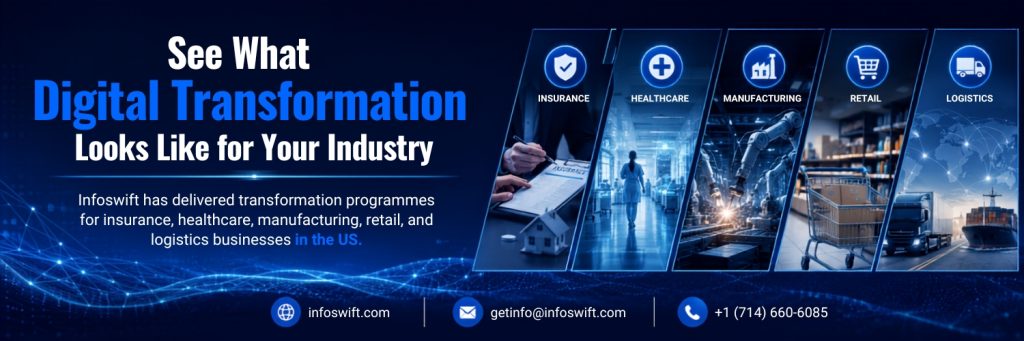
Infoswift has delivered transformation programmes for businesses in insurance, healthcare, manufacturing, retail, agriculture, logistics, and professional services. Our team includes engineers, architects, data scientists, and delivery managers who have built production systems in each of these industries.
Frequently Asked Questions About digital transformation
Digital transformation solutions are the combination of technology, process redesign, and organisational capability that allows a business to fundamentally change how it operates. They include custom software development, cloud migration, business process automation, AI integration, system integration, and data analytics. The term refers to the full programme of change, not to any single technology purchase.
End-to-end digital transformation means addressing every layer of a business’s technology and operations rather than solving one problem in isolation. It covers the full stack from infrastructure and cloud to applications, integrations, automation, data, and customer-facing systems. End-to-end transformation is significant because most technology investments that fail do so because they solve one layer without addressing the dependencies above and below it.
Growing businesses face a specific version of the transformation imperative. The manual processes and legacy systems that were adequate at an earlier stage become active constraints on growth: they limit the volume of transactions the business can handle, the speed at which it can serve customers, and the quality of decisions leadership can make. Digital transformation solutions for businesses at this stage convert those constraints into capabilities.
Digital transformation technologies include cloud platforms such as AWS, Microsoft Azure, and Google Cloud; custom software built on modern frameworks; AI and machine learning tools for intelligent automation; API integration platforms; business intelligence and analytics tools; robotic process automation for rule-based workflow execution; and mobile application development for field and customer-facing operations. The right technology selection depends on the specific problem being solved rather than on general market preferences.
The cost of a digital transformation programme varies significantly based on the scope, the number of systems being addressed, the degree of custom development required, and the business complexity. A focused transformation of two or three core business processes typically starts from $80,000 to $200,000. A comprehensive enterprise-wide transformation programme may range from $500,000 to several million over a multi-year roadmap. Infoswift provides detailed cost estimates based on a documented scope assessment, not generic ranges.
A focused first-phase transformation initiative covering one to two business processes or system replacements typically takes three to six months from requirements sign-off to deployment. A comprehensive transformation roadmap is typically a 12 to 36 month programme of sequential and parallel initiatives. The critical distinction is between the first measurable result, which should come within 90 to 180 days of the first initiative going live, and the complete transformation of the business, which takes longer.
AI digital transformation adds intelligent automation to the transformation programme where rules-based automation reaches its limits. Specifically, AI is valuable in transformation programmes for: processing high volumes of unstructured documents such as contracts, invoices, and claims; forecasting demand, risk, or maintenance requirements based on historical patterns; detecting anomalies in operational or financial data that would not trigger rule-based alerts; and personalising customer interactions at scale. AI is most effective as part of a transformation programme when the data infrastructure is already in place to feed it.
Evaluate a digital transformation company on: whether they have delivered transformation in your specific industry, not just claimed capability; whether their process begins with assessment and strategy before development; whether they can name the actual team that will build your solution before you sign; whether they have transparent post-deployment support terms; and whether they have given clients honest assessments that something was not the right investment rather than always saying yes. Infoswift is willing to answer all of these questions directly.
Digital transformation is not optional for growing businesses. It is the mechanism by which a business that is outgrowing its current tools and processes builds the capability to grow further without those constraints becoming hard ceilings on what is achievable.
The businesses that do it well treat transformation as a strategy, not a technology purchase. They start with clarity about what they are trying to achieve, sequence their initiatives to build on each other, and partner with teams who have delivered in their industry before. The businesses that do it poorly buy technology before defining the problem, deploy without redesigning the process, and then question whether transformation was worth it.
If your business is at the inflection point where the systems and processes that got you here are visibly holding back where you need to go, the next step is a conversation. Infoswift is ready to have it.