
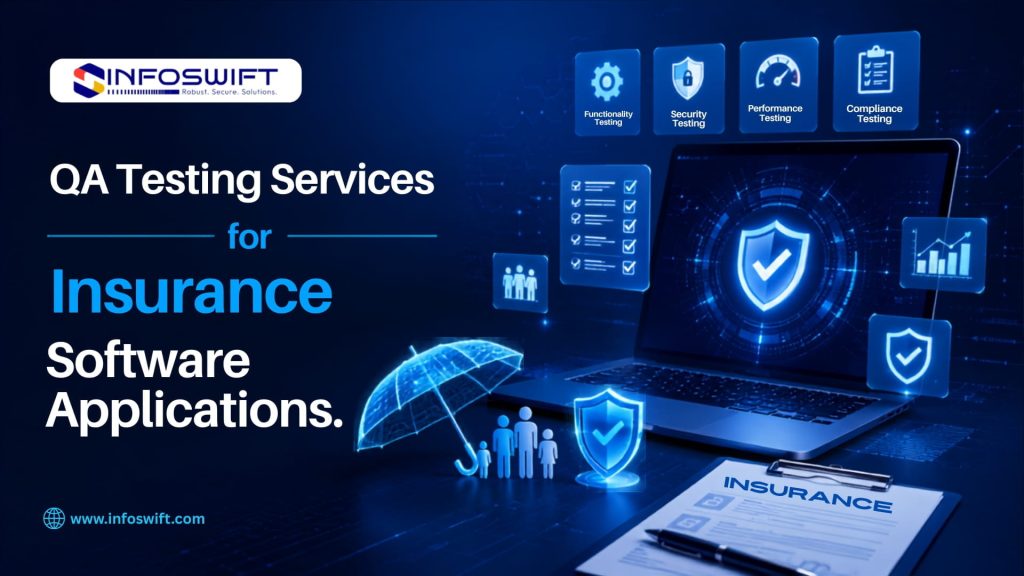
QA Testing Services for Insurance Software Applications: Ensuring Quality, Security & Compliance
Key Takeaways
- Insurance software testing is specialized QA that validates complex policy, quote, claims, and billing logic before it reaches production.
- For US insurers, quality assurance testing is tied directly to compliance HIPAA/HITECH, state DOI rules, SOC 2, and CCPA/CPRA all raise the stakes on defects and data exposure.
- The core testing types for insurance apps are functional, automation, regression, performance, security, API, and user acceptance testing (UAT).
- Automation testing services shorten regression cycles, expand coverage, and fit CI/CD essential when carriers ship frequent releases.
- Professional QA testing services reduce production defects, protect customer data, and lower long-term maintenance costs.
- InfoSwift delivers end-to-end insurance application testing with domain expertise, an automation-first approach, and enterprise-grade security.
Insurance runs on software quoting engines, policy administration systems, claims platforms, member portals, and the APIs that tie them to carriers, payment processors, and CRMs. When any of that breaks, the cost is not just a bug ticket. A miscalculated premium, a failed claim submission, or an exposed customer record can mean lost trust, regulatory scrutiny, and real financial loss. That is why insurance software testing has become a core part of how US insurers, agencies, and insurtech companies build and ship. Reliable applications are now a competitive requirement, not a nice-to-have.
This guide explains what QA testing services for insurance applications actually involve, the specific risks that make insurance different from generic software testing services, and the testing types every insurance platform needs.
What Is Insurance Software Testing?
Insurance software testing is the practice of validating insurance applications quoting, underwriting, policy administration, claims, billing, and customer portals against their functional, performance, security, and compliance requirements before and after release. It is a specialized branch of quality assurance because insurance software carries unusually complex business rules and handles highly sensitive personal and financial data.
Generic insurance application testing that only checks whether buttons work misses the point. Insurance logic is layered: a single quote can depend on state, coverage type, risk factors, rating tables, discounts, and regulatory limits. Premium and claims calculations must be exact, because an error repeated across thousands of policies compounds quickly. And because insurers are custodians of protected data, testing has to prove not just that the app works, but that it is secure and compliant. That combination intricate rules plus sensitive data plus regulation is why insurance applications require dedicated QA rather than a general test pass.
Why QA Testing Is Critical for Insurance Applications
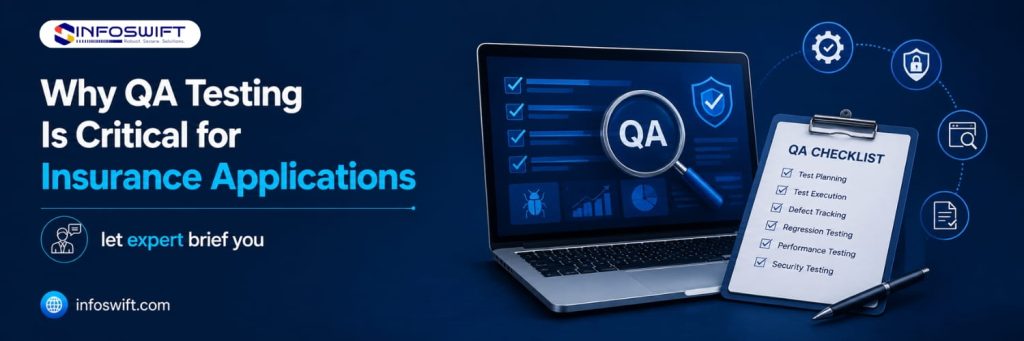
For insurers, quality assurance testing is directly tied to trust, revenue, and regulatory standing. Professional QA testing services protect the business in ways that are easy to underestimate until something fails:
- Customer trust: Policyholders expect accurate quotes, correct billing, and claims that pay out as promised. Defects erode confidence fast and drive churn.
- Accurate premium calculations: Rating and premium logic must be precise. A rounding or rule error can under- or over-charge customers at scale and trigger disputes.
- Secure customer data: Insurance apps hold PII, payment details, and often health data. QA must verify encryption, access controls, and data handling.
- Regulatory compliance: US insurers navigate state Department of Insurance (DOI) requirements, and health-related data brings HIPAA and HITECH into scope, alongside SOC 2 expectations and state privacy laws like CCPA/CPRA. Testing provides the evidence that controls work.
- Business continuity: High-volume platforms must stay up during peak enrollment and renewal periods. QA validates stability under load.
- Reduced production issues: Catching defects before release is dramatically cheaper than fixing them in production, where they affect real customers and real money.
Common Challenges in Insurance Software Testing
Insurance platforms present testing challenges that most industries never encounter. Understanding them is the first step to testing effectively:
- Complex business rules that vary by product, state, and customer segment
- Policy calculations and rating logic that must be validated exhaustively, not sampled
- Quote accuracy across countless input combinations and edge cases
- Multi-step claims workflows with approvals, exceptions, and settlements
- Legacy system integration, since many carriers still run core systems built decades ago
- Third-party API integration with carriers, payment gateways, and CRMs
- Regulatory compliance that differs across all 50 states and evolves over time
- High-volume transactions during open enrollment, renewals, and catastrophe events
Types of QA Testing for Insurance Software
Comprehensive software testing services for insurance combine several testing types, each targeting a different kind of risk. A mature QA program uses all of them in the right proportion.
Functional Testing
Functional testing verifies that every core insurance workflow behaves exactly as specified across quotes, policies, claims, renewals, and billing. This is where quote accuracy, premium calculation, endorsement handling, and claims outcomes are validated against business rules, so customers get correct results every time.
Automation Testing
Automation testing services use scripted, repeatable tests to cover functionality that would take too long to check by hand. For insurance, insurance automation testing is especially valuable because carriers release frequently and regression surfaces are large. The benefits are concrete: faster regression cycles, reduced manual effort, and native support for CI/CD pipelines so tests run automatically on every build.
Regression Testing
Regression testing ensures that new releases, patches, and configuration changes don’t break existing functionality. In insurance, where rating tables and product rules change constantly, disciplined regression testing is what keeps a working platform working after every update.
Performance Testing
Performance testing services validate how an application behaves under real-world stress: peak traffic during open enrollment, thousands of concurrent users, acceptable response times, and the ability to scale. For insurers, a portal that slows or fails during renewal season is a direct hit to revenue and reputation.
Security Testing
Security testing protects the sensitive data insurance apps hold. It covers data protection and encryption, authentication and authorization, and vulnerability assessment against threats. For US insurers handling health data, security testing also supports HIPAA-aligned safeguards; more broadly, it underpins SOC 2 and state data-security expectations. Regular vulnerability assessment and, where required, penetration testing are part of a defensible security posture.
API Testing
API testing validates the integrations that hold an insurance ecosystem together carrier APIs, payment gateways, CRM integrations, and policy management APIs. Because so much insurance functionality now runs through these connections, API testing confirms that data passes accurately and securely between systems, with correct handling of errors and edge cases.
User Acceptance Testing (UAT)
UAT is the final check that an application meets real business requirements before launch. Business stakeholders and end users validate that the software does what the organization actually needs not just what the specification said catching gaps between requirements and reality while they’re still cheap to fix.
Benefits of Professional QA Testing Services
The difference between shipping with and without professional QA testing services shows up quickly. Here’s how insurance applications compare with and without a mature QA partner:
Without QA | With InfoSwift QA |
Frequent bugs in production | Stable, predictable releases |
Slow, inconsistent performance | Optimized, load-tested applications |
Security and data-exposure risks | Secure, compliance-ready software |
Slow manual testing | Efficient automated testing |
Customer complaints and churn | Better user experience and retention |
High long-term maintenance costs | Lower total cost of ownership |
Across those rows, the tangible benefits of professional software testing services are consistent: improved software quality, faster releases, a better customer experience, fewer defects, lower maintenance costs, and greater reliability. For insurers, each of those maps directly to protected revenue and reduced regulatory risk.
Why Automation Testing Is Essential for Insurance Software
Modern insurance platforms ship on short cycles, and every release risks regressions in complex rating and claims logic. That’s why automation testing services have moved from optional to essential. Insurance automation testing delivers value that manual testing simply can’t match at scale:
- Keeps pace with frequent releases without ballooning QA timelines
- Runs faster testing cycles, so feedback reaches developers in minutes, not days
- Expands test coverage across combinations no manual team could exhaust
- Integrates with CI/CD so tests execute automatically on every build
- Reduces manual effort, freeing QA engineers for higher-value exploratory and edge-case testing
The most effective approach is not automation for its own sake, but an automation-first strategy that automates stable, high-value regression paths while keeping skilled manual testing where human judgment matters most.
How InfoSwift Delivers QA Testing Services for Insurance Software
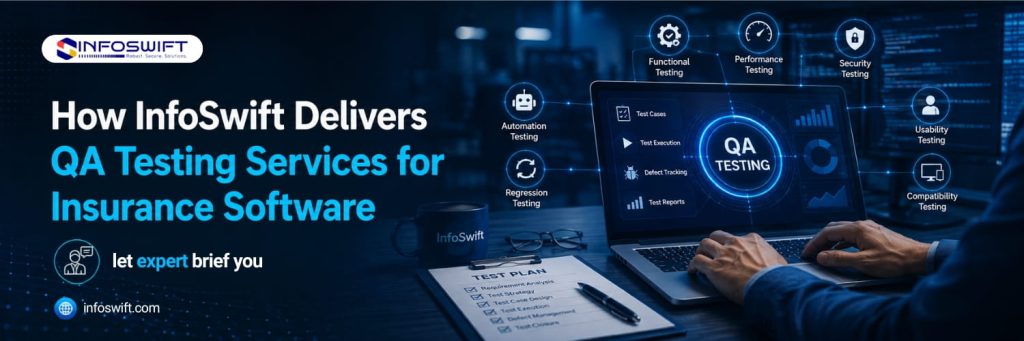
InfoSwift provides end-to-end quality assurance for insurance applications, combining insurance domain knowledge with a full-stack testing capability. Our services span the complete QA lifecycle for carriers, agencies, and insurtech platforms:
- Manual and exploratory testing for complex, judgment-heavy scenarios
- Automation testing and framework development for scalable regression
- API testing across carrier, payment, and CRM integrations
- Functional and regression testing across quotes, policies, and claims
- Performance and load testing for peak-season readiness
- Security testing and vulnerability assessment for sensitive data
- Mobile app and web application testing across devices and browsers
- Specialized testing for insurance quote portals, claims systems, and policy management platforms
- CI/CD testing integration so QA runs continuously, not just at the end
Why Choose InfoSwift?
Choosing a testing partner for insurance software is a decision about risk. InfoSwift is built to reduce it:
- Insurance domain expertise we understand policy, quote, and claims logic, not just generic apps
- Experienced QA engineers who’ve tested real insurance platforms
- An automation-first approach that scales coverage and speeds releases
- Agile testing methodology aligned to your sprints and pipelines
- Enterprise-grade security practices for sensitive customer data
- Faster release cycles without sacrificing quality
- Scalable testing solutions that grow with your platform
- End-to-end QA support, from strategy through continuous testing
Insurance software testing is specialized quality assurance that validates insurance applications quoting, underwriting, policy administration, claims, billing, and portals against their functional, performance, security, and compliance requirements. It exists because insurance software carries complex business rules and sensitive data that generic testing isn’t designed to handle.
QA testing services protect customer trust, ensure accurate premium and claims calculations, secure sensitive data, and support regulatory compliance. For US insurers, defects can trigger customer disputes, data-exposure risk, and regulatory scrutiny under HIPAA, state DOI rules, and privacy laws, so professional QA directly reduces business and compliance risk.
Insurance software typically requires functional, automation, regression, performance, security, API, and user acceptance testing (UAT). Functional and regression testing confirm the business logic is correct, performance testing prepares for peak load, security and API testing protect data and integrations, and UAT confirms the app meets real business needs before launch.
Automation testing speeds up regression cycles, expands test coverage, reduces manual effort, and integrates with CI/CD so tests run on every build. For insurers that release frequently, insurance automation testing keeps quality high without slowing delivery catching regressions in rating and claims logic before they reach customers.
QA teams use a mix of automation frameworks (such as Selenium, Playwright, or Cypress for web, and Appium for mobile), API testing tools (such as Postman or REST Assured), performance testing tools (such as JMeter or k6), and CI/CD platforms to run tests continuously. The right toolset depends on your technology stack, which InfoSwift assesses before recommending an approach.
Yes. Catching defects before production is far cheaper than fixing them after release, when they affect live customers and require emergency work. Professional QA reduces rework, lowers long-term maintenance costs, and prevents expensive production incidents so quality assurance testing typically pays for itself over the life of an application.
InfoSwift combines insurance domain expertise with full-lifecycle testing manual, automation, API, performance, and security delivered by experienced QA engineers using an automation-first, agile approach. We test the platforms insurers actually run, including quote portals, claims systems, and policy management, with enterprise-grade security throughout.
Insurance software should be tested continuously, not just at release. Every code change, rating-table update, and integration change should trigger automated regression tests, with fuller functional, performance, and security testing at each major release and periodic security assessments in between. Continuous testing through CI/CD is the practical standard for insurance platforms today.