
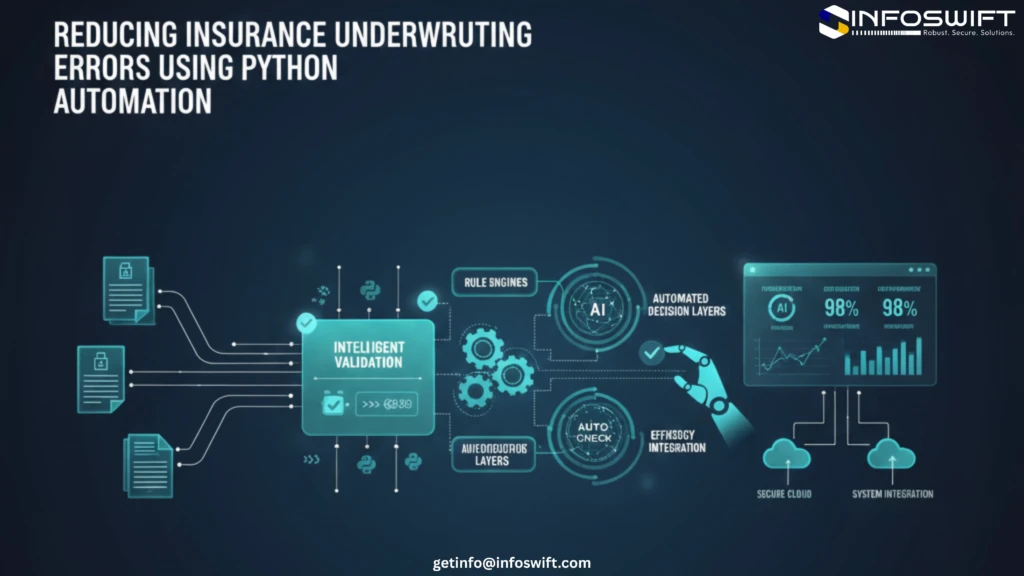
Reducing Insurance Underwriting Errors Using Python Automation
Key Takeaways
Manual underwriting processes are one of the biggest causes of policy errors, delays, and compliance risks in insurance.
Python automation helps insurers reduce underwriting errors by validating data, standardizing risk evaluation, and flagging inconsistencies early.
Automated underwriting improves accuracy, speeds up policy issuance, and ensures regulatory compliance.
Python-based bots can integrate seamlessly with existing insurance systems, CRMs, and third-party data providers.
Infoswift helps insurance companies design secure, scalable Python automation solutions tailored to underwriting workflows.
Why Underwriting Errors Are a Growing Risk for Insurance Companies
Underwriting sits at the core of insurance operations. Every decision directly impacts risk exposure, pricing accuracy, customer trust, and regulatory compliance. Yet, many insurers still rely on manual data entry, spreadsheet-based calculations, and fragmented systems.
Common underwriting challenges include:
Inconsistent risk assessment across underwriters
Manual data entry errors
Missing or outdated applicant information
Delayed policy approvals
Compliance gaps caused by human oversight
As insurance volumes grow and regulations tighten, even small underwriting mistakes can lead to financial losses, claim disputes, or regulatory penalties. This is where Python automation becomes a powerful solution.
How Python Automation Improves Underwriting Accuracy
Python is widely used in insurance automation because it is flexible, reliable, and ideal for handling complex data workflows. When applied to underwriting, Python automation helps eliminate repetitive manual tasks while ensuring consistent decision-making.
Python-based automation can:
Validate applicant data in real time
Apply standardized underwriting rules
Cross-check risk parameters across multiple data sources
Flagught errors before policy issuance
Instead of underwriters manually reviewing every data point, automation handles validation while underwriters focus on decision quality.
Common Underwriting Errors Python Automation Helps Eliminate
Data Entry and Validation Errors
Manual data entry increases the risk of incorrect personal details, coverage amounts, or risk attributes. Python bots can validate data against predefined rules and external sources before underwriting begins.
Inconsistent Risk Assessment
Different underwriters may interpret the same data differently. Python automation applies consistent risk scoring logic across all applications, ensuring uniform underwriting decisions.
Missing Documentation and Compliance Gaps
Automation workflows can verify required documents, check compliance conditions, and alert teams when information is missing or outdated.
Delayed Application Processing
Python-powered automation processes applications faster, reducing turnaround time without compromising accuracy.
Automating Data Validation to Prevent Underwriting Errors
One of the most common sources of underwriting mistakes is incorrect or incomplete data. Python automation can automatically validate data at every stage of the underwriting process.
Examples include:
Verifying age, address, and identity details
Checking medical or financial records for missing fields
Detecting duplicate or conflicting entries
Validating policy eligibility rules
By catching errors early, insurers reduce rework, delays, and customer dissatisfaction.
Standardizing Risk Assessment with Python-Based Rules Engines
Different underwriters assessing the same case often reach different conclusions. Python automation allows insurers to standardize risk evaluation using rule-based engines.
Benefits of standardized underwriting automation:
Consistent risk scoring across policies
Reduced bias in underwriting decisions
Transparent audit trails for compliance
Faster approval cycles
Python scripts apply the same underwriting logic every time, ensuring fairness and accuracy while reducing dependency on manual judgment for routine cases.
Using Python Bots for Intelligent Underwriting Workflows
Python-based bots act as digital assistants within underwriting systems. They can:
Extract and process data from forms, PDFs, and APIs
Cross-check customer information with third-party databases
Trigger automated approvals or escalations
Generate audit-ready logs for compliance teams
These bots reduce manual workload while maintaining transparency and control throughout the underwriting lifecycle.
Using Python Automation to Detect Anomalies and Fraud Risks
Underwriting errors are not always accidental. In some cases, incorrect data may indicate fraud or risk manipulation.
Python automation can:
Flag unusual patterns in applicant data
Detect mismatches between declared and verified information
Identify high-risk applications based on historical data
Alert underwriters before approval
This proactive approach protects insurers from issuing policies that later turn into costly claims.
Compliance and Risk Control Through Automated Underwriting
Regulatory compliance is non-negotiable in insurance. Python automation strengthens compliance by:
Enforcing underwriting rules automatically
Maintaining accurate audit trails
Reducing manual interpretation risks
Supporting regulatory reporting with structured data
Automated checks ensure that underwriting decisions remain consistent, explainable, and defensible.
Integrating Python Automation with Insurance Systems
Python automation works best when integrated with existing insurance platforms. Python-based bots can connect with:
Policy management systems
CRM platforms
Third-party data providers
Claims and billing systems
This ensures underwriting decisions are based on accurate, real-time information rather than fragmented datasets.
Infoswift designs Python automation solutions that integrate seamlessly without disrupting ongoing operations.
Real Business Impact of Python Automation in Insurance Underwriting
Insurance companies using Python automation report:
Significant reduction in underwriting errors
Faster policy issuance and approvals
Improved customer satisfaction
Lower operational costs
Better risk selection and loss control
Automation does not replace underwriters. It empowers them with accurate data, faster insights, and consistent decision support.
Why Infoswift Is the Right Partner for Insurance Automation
Infoswift specializes in building intelligent automation solutions for insurance companies using Python, APIs, and microservices. Our approach focuses on real-world business outcomes, not just technology.
With Infoswift, insurers gain:
Custom Python automation tailored to underwriting workflows
Secure, scalable architecture built for regulatory environments
Seamless integration with existing insurance systems
Ongoing optimization and support
We help insurance teams reduce errors, improve efficiency, and make underwriting more reliable.
Final Thoughts: Smarter Underwriting Starts with Automation
Reducing underwriting errors is no longer optional for insurance companies operating in competitive and regulated markets. Python automation brings consistency, accuracy, and speed to underwriting workflows while allowing teams to focus on complex decision-making.
By automating validation, risk assessment, and compliance checks, insurers can build trust, protect margins, and scale confidently.
Looking to reduce underwriting errors with Python automation?
Infoswift helps insurance companies design intelligent, secure automation solutions that improve accuracy and speed.
Explore how our bot and automation services can transform your underwriting process.