Custom ERP Software Development: Complete Guide for Businesses
KEY TAKEAWAYS |
|
|
|
|
|
Most growing businesses hit the same wall. The spreadsheets that worked at ten employees break at fifty. Finance does not talk to inventory. Sales is working from data the operations team updated three days ago. Every department is running hard, but nobody has a complete picture of what is actually happening in the business.
This is not a people problem. It is a systems problem. Custom ERP software development solves it by connecting every core business function on one centralized platform, automating routine workflows, and giving leadership the real-time visibility they need to make better decisions faster.
What Is Custom ERP Software Development?
ERP stands for Enterprise Resource Planning. A custom ERP system is built specifically for one business rather than purchased off a shelf and adapted to fit. The distinction matters more than most businesses initially realize.
Ready-made ERP platforms like SAP, Oracle, and NetSuite are built for a broad market. They contain features most businesses will never use and frequently lack the specific workflows or integrations a particular business requires. The customization needed to make a generic platform fit a specific business often costs more than building one from scratch, and it creates a system that breaks every time the base platform updates.
Custom ERP is the right choice when workflows are unique, compliance requirements are industry-specific, data ownership matters, or the long-term cost of licensing and customizing a commercial platform exceeds building a dedicated solution.
Benefits of Custom ERP Software Development
The business case for custom ERP is built on immediate operational improvements and long-term strategic advantages:
- Centralized data. Centralized data eliminates version conflicts and the reconciliation work that consumes staff time across departments.
- Process automation. Process automation removes human intervention from routine workflows, reducing errors and freeing people for higher-value work.
- Real-time visibility. Real-time visibility across inventory, finance, and sales means problems are identified before they become expensive.
- Scalability. Scalability is built into the architecture from day one. The platform grows with the business without requiring replacement.
- Reduced costs. Reduced costs come from automation, error reduction, better procurement management, and eliminating multiple software licensing fees.
- Enhanced security. Enhanced security through role-based access control and centralized data governance reduces exposure versus data spread across multiple systems.
How custom ERP compares to the systems it replaces:
Traditional Systems | Custom ERP with Infoswift |
Multiple disconnected apps | One centralized platform |
Manual data entry | Automated workflows |
Data silos per department | Unified, shared data |
Delayed, static reports | Real-time dashboards |
Hard to scale | Modular, grows with you |
Key Modules of Custom ERP Software
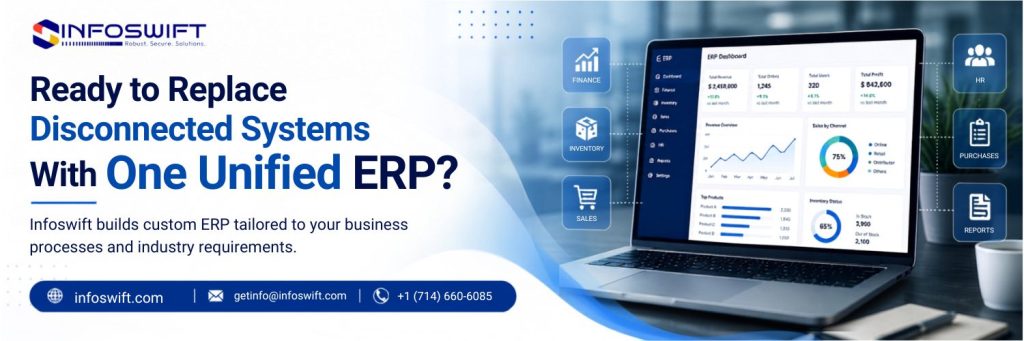
A custom ERP is built from the modules the business actually needs. Infoswift builds the following most frequently:
Finance and Accounting: Invoicing, accounts payable and receivable, financial reporting, budget management, and audit trail documentation. Every transaction across the business flows through the financial module, creating a single source of financial truth.
Inventory Management: Real-time stock tracking across all locations, warehouse management, automated reorder alerts, and purchase management. Inventory data connects directly to sales and procurement so every department works from the same numbers.
Sales and CRM: Lead management, customer records, sales pipeline tracking, and order management from quote through fulfilment. Sales data flows in real time to inventory and finance, eliminating the delays that cause fulfilment errors.
Human Resources: Employee records, payroll processing, attendance and time tracking, leave management with approval workflows, and self-service portals that reduce HR team workload significantly.
Procurement: Vendor records, purchase orders, multi-level approval workflows, three-way matching of purchase orders and invoices, and spend analytics that surface cost reduction opportunities.
Reporting and Analytics: Configurable dashboards for each department and role, real-time reports on any tracked metric, KPI alerting, and data export for external reporting. This is the layer that turns the ERP from a data storage system into a decision-making tool.
How AI and Automation Are Transforming ERP Systems
AI capabilities in ERP are not a future-state promise. They are deployed today and producing measurable results for Infoswift clients.
The most impactful applications:
- Document processing. Automated document processing extracts structured data from invoices, purchase orders, and contracts without manual entry.
- Demand forecasting. Intelligent demand forecasting uses machine learning to predict inventory requirements more accurately than rule-based methods.
- Predictive analytics. Predictive analytics surface business risks and opportunities before they appear in standard reporting.
- Workflow automation. Workflow automation handles routine decisions automatically, escalating only exceptions to human review.
- AI reporting. AI-powered reporting generates insights from operational data without requiring analysts to review every metric manually.
Custom ERP Software Development Process
Infoswift follows an eight-step delivery methodology refined across dozens of enterprise ERP engagements:
- Business Requirement Analysis Document current processes, pain points, and the specific outcomes the ERP must deliver.
- ERP Strategy and Planning Define modules, integration architecture, technology stack, and delivery roadmap with measurable milestones.
- UI/UX Design Role-specific interfaces designed around actual user workflows, validated with real end users before development begins.
- ERP Development Agile sprint development with regular client reviews so requirement changes are caught early, not at delivery.
- Integration Connect ERP to existing business systems via API with monitoring so integration failures are caught and resolved quickly.
- QA and Testing Functional, performance, security, and regression testing embedded throughout development, not applied only at the end.
- Deployment Phased rollout with parallel running periods, data migration with validation at every stage, and role-specific user training.
- Support and Optimization Performance monitoring, bug resolution, feature additions as business requirements evolve, and regular review sessions post-deployment.
How Infoswift Helps Businesses Build Custom ERP Software
Infoswift is a custom software development company with deep experience in ERP system development across regulated and operationally complex industries. We build ERP systems from the ground up, modernize legacy ERP platforms, and extend existing installations with custom modules and integrations.
- Custom ERP software development from requirements through deployment.
- ERP application modernization for businesses running outdated platforms.
- Cloud ERP development on AWS, Azure, and Google Cloud with appropriate security and compliance architecture.
- AI-powered ERP capabilities including intelligent forecasting, automated document processing, and predictive analytics.
- API development and integration for connecting ERP with any existing or third-party business system.
- QA and testing embedded throughout, plus ongoing maintenance and continuous improvement post-deployment.
Industries That Benefit From Custom ERP Software
- Manufacturing. Manufacturing: production planning, inventory, procurement, and quality control connected in real time.
- Insurance. Insurance: policy lifecycle, customer and agent records, claims processing, and compliance reporting on one platform.
- Healthcare. Healthcare: patient management, billing, operational workflows, and HIPAA-compliant data handling.
- Retail and E-commerce. Retail and E-commerce: real-time inventory synchronization across channels, order management, and customer data.
- Logistics. Logistics: fleet management, warehouse operations, shipment tracking, and supply chain visibility.
- Professional Services. Professional Services: project management, resource allocation, time tracking, and automated client billing.
Frequently Asked Questions About custom ERP Software
It is the process of designing and building an ERP system specifically for one business rather than deploying a generic off-the-shelf platform. The result reflects the business’s actual workflows, industry requirements, and integration needs.
Generic platforms require expensive customization that often costs more than a custom build, creates systems that break during vendor updates, and still leaves gaps. Custom ERP is right when workflows are unique, compliance requirements are specific, or long-term licensing and customization costs exceed the cost of building a dedicated solution.
A focused ERP covering three to four modules with standard integrations typically takes four to six months. A comprehensive ERP with six or more modules, AI capabilities, and complex integrations typically takes nine to twelve months.
Yes. Infoswift builds ERP on API-first architecture, which means the system connects with any existing or future business tool including CRM, accounting software, payment gateways, e-commerce platforms, HR systems, and supply chain tools. New integrations can be added without changes to the ERP core.
Yes, and it produces measurable results. Infoswift integrates automated document processing, intelligent demand forecasting, predictive analytics, and AI-powered reporting directly into ERP systems. AI capabilities are most effective when designed into the ERP architecture from the beginning rather than added later.
Evaluate partners on: industry experience with provable delivery history, a structured methodology with clear milestones, genuine QA capability embedded in delivery, transparent post-deployment support terms, and willingness to introduce you to the actual team that will build your system before you sign anything.
Disconnected systems are not just inefficient. They are a strategic liability. Every manual handoff is a potential error. Every data silo is a decision made on incomplete information. Every spreadsheet workaround is a sign that the tools the business runs on are no longer adequate for the business it has become.
Custom ERP software development solves this at the root. Not by adding another application to the stack, but by replacing fragmentation with a single platform that connects every function, automates the workflows that should not require human intervention, and gives leadership the real-time visibility to run the business with confidence.
If your current systems are holding the business back, the conversation about what a custom ERP would look like for your specific operations is a good place to start. Infoswift is ready when you are.