
Insurance Workflow Automation: Reduce Manual Processing with AI and RPA
Key Takeaways
- Insurance workflow automation connects and automates the end-to-end insurance process from quote generation to claims settlement eliminating manual handoffs, reducing errors, and accelerating every stage of the policy lifecycle.
- RPA for insurance deploys software bots that execute repetitive, rule-based tasks at machine speed data entry, document processing, policy updates, compliance checks without human involvement.
- AI-powered insurance automation goes further than RPA: it learns from data, makes intelligent decisions, and handles unstructured inputs like handwritten forms, scanned documents, and free-text claim descriptions.
- Insurance automation software reduces claims processing time by up to 80%, cuts operational costs per policy, and enables carriers, MGAs, and agencies to scale volume without proportional headcount increases.
- Quote generation, underwriting, claims processing, policy renewals, compliance management, and customer support are the six highest-ROI processes to automate first.
- InfoSwift builds custom insurance automation solutions from individual workflow automations to full intelligent insurance platforms for carriers, MGAs, agencies, and brokers across the US.
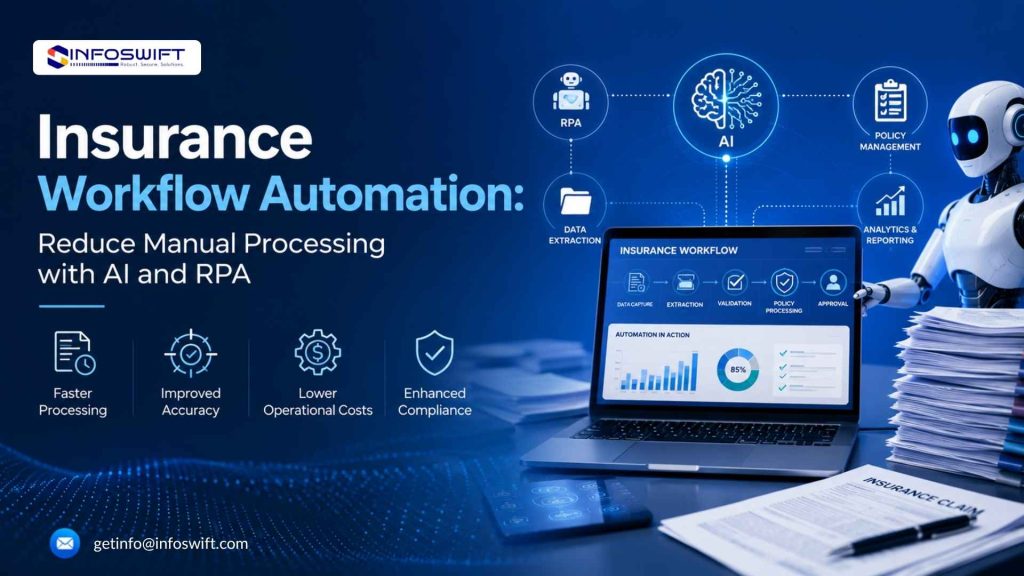
The insurance industry is under pressure from three directions simultaneously: customers expecting faster digital service, regulators demanding tighter compliance documentation, and operations struggling with document volumes that manual teams cannot process efficiently. Automation in insurance is the response that addresses all three at the same time.
Insurance process automation combines AI, robotic process automation, and intelligent workflow tools to handle the repetitive, high-volume tasks that currently consume underwriter, adjuster, and compliance team capacity. The result: faster service, lower error rates, reduced operating costs, and an operation that scales with volume rather than headcount.
This guide covers every dimension of insurance workflow automation what it is, how RPA and AI work together, which processes to automate first, and how to choose the right technology partner.
What Is Insurance Workflow Automation?
Insurance workflow automation is the use of software technology to connect, execute, and manage insurance processes without manual intervention at every step. Instead of an underwriter manually extracting data from a submission, routing it to the right team, chasing approvals, and entering it into the policy system an automated workflow handles each step automatically, in sequence, at machine speed.
Traditional automation vs AI-powered insurance automation:
- Traditional automation: Rule-based scripts that follow fixed logic. Effective for consistent, high-volume repetitive tasks. Cannot handle variability, unstructured data, or decisions that require interpretation.
- AI-powered automation: Intelligent systems that read unstructured documents, make decisions based on learned patterns, adapt to new scenarios, and improve continuously. Handles the variability that rules-based systems cannot.
The most effective insurance automation strategies combine both rules-based automation for high-volume structured tasks and AI for the document-intensive, decision-heavy processes that previously required human judgment.
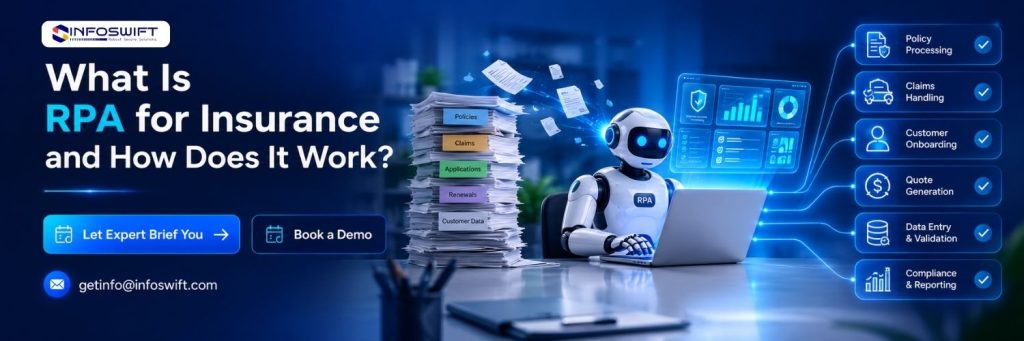
What Is RPA for Insurance and How Does It Work?
RPA for insurance uses software robots automated bots that mimic human actions in digital systems. An RPA bot can log into a portal, extract data from a document, copy it into a policy system, run a validation check, send a notification, and log the action in a compliance record repeatedly, accurately, and without breaks.
How RPA works across insurance operations:
- Bots access the same applications human staff use — no system replacement required
- Triggered by events: a new submission, an incoming claim, a renewal date, a compliance deadline
- Execute defined sequences extract, validate, enter, route, notify at machine speed
- Log every action with a timestamp for full audit trail and regulatory documentation
AI + RPA = Intelligent Process Automation: When AI is layered on top of RPA, bots can handle inputs that rules-based automation cannot reading a handwritten FNOL form, classifying an incoming email, extracting clauses from a scanned policy, or scoring a claim for fraud risk. This combination is what separates basic insurance automation software from a genuine intelligent automation platform.
Why Insurance Companies Are Investing in Automation Now
The business case for insurance workflow automation is no longer theoretical. These six operational pressures are driving adoption across the industry:
- Increasing policy volume: More policies, more endorsements, more renewals processed by the same size team. Manual processes cannot scale with volume without proportional cost increases.
- Manual data entry errors: Human data entry on insurance forms carries a 1–4% error rate. On a portfolio of 10,000 policies, that is up to 400 errors requiring rework, dispute resolution, or compliance remediation.
- Slow underwriting decisions: Manual submission review, data extraction, and risk assessment take days. Brokers submit the same risk to multiple carriers the one that quotes fastest wins the business.
- Claims processing delays: Policyholders filing a claim in a stressful moment expect fast acknowledgement and faster resolution. Manual claims intake creates delays that drive customer churn and complaints.
- Compliance complexity: Regulatory requirements change across jurisdictions and product lines. A manual compliance process dependent on individual knowledge is a liability every time requirements update.
- Rising operational costs: The fully-loaded cost of manual processing staff, error correction, rework, and management overhead makes it one of the highest per-transaction costs in financial services.
Key Insurance Processes You Can Automate and What Each Delivers
These six process areas represent the highest ROI targets for insurance workflow automation. Each can be deployed independently or as part of a connected intelligent automation platform.
Quote Generation and Policy Issuance
- Quote generation: AI pulls customer data, applies underwriting rules, calculates premiums, and generates a quote in seconds. No manual data entry. No underwriter involvement for standard risks.
- Policy issuance: Once accepted, automation generates policy documents, triggers digital approvals, and creates the policy record in the system from quote acceptance to issued policy in minutes.
Underwriting Automation
- Risk assessment: AI models analyse submission data, loss history, and third-party risk data simultaneously producing a risk score and coverage recommendation without manual review for standard cases.
- Document validation: AI extracts and validates data from submission packages applications, loss runs, supporting documents automatically, reducing submission-to-decision time from days to hours.
Claims Processing Automation
- FNOL automation: First Notice of Loss intake from phone, portal, or email is processed automatically. Incident details are extracted, the relevant policy is retrieved, and the claim record is created without manual entry.
- Document verification: Claim supporting documents adjuster reports, medical records, repair estimates are extracted, classified, and validated by AI as they arrive.
- Fraud detection: Machine learning scores every claim in real time for fraud signals before payment is approved. Network analysis identifies organised fraud across multiple claims.
- Settlement workflows: Simple claims within defined parameters are approved and settled automatically. Complex claims are escalated with all data pre-assembled for adjuster review.
Policy Renewals and Customer Notifications
Automated renewal workflows send advance notifications to policyholders, generate renewal offers based on current rating data, and process renewals without manual intervention for standard policies. Lapse rates fall when customers receive timely, personalised renewal communications triggered automatically by the system.
Customer Support Automation
- AI chatbots: Handle claims status, policy questions, payment enquiries, and document requests 24/7 without agent involvement. Escalate to human agents with full context when required.
- Self-service portals: Policyholders and brokers access policy documents, submit claims, request endorsements, and track status without calling a service centre.
- Ticket automation: Inbound service requests are classified, prioritised, and routed to the correct team automatically based on request type and customer profile.
Compliance Management
- Regulatory validation: Every policy, endorsement, and renewal is validated against current regulatory requirements for that product and jurisdiction automatically, before issuance.
- Audit trail: Every automated action is logged with a timestamp, actor (human or bot), and data source. Audit-ready documentation is produced without manual record-keeping.
- Reporting: Compliance dashboards surface exceptions, non-conforming policies, and upcoming regulatory deadlines in real time replacing manual compliance monitoring entirely.
What to Look for in Insurance Automation Software
Production-grade insurance automation software must include these capabilities to handle real-world insurance operations at scale:
- AI document processing (OCR + NLP): Reads any document format scanned PDFs, handwritten forms, structured submissions extracting structured data without manual entry.
- Workflow builder: Configurable, low-code workflow design that lets operations teams build, modify, and deploy automated workflows without developer dependency at every change.
- Business rules engine: Encodes underwriting guidelines, compliance requirements, approval thresholds, and routing logic into automated decision rules that apply consistently across every transaction.
- API integrations: Connects to CRM, policy management systems, payment gateways, email, SMS, and ERP without requiring system replacement. Pre-built connectors reduce integration timelines significantly.
- Analytics and KPI dashboard: Real-time visibility into workflow performance processing volumes, cycle times, error rates, SLA compliance, and automation coverage for operations and management teams.
- Role-based access control: Granular permission management ensures the right staff access the right processes. Full audit trail for regulatory compliance and internal governance.
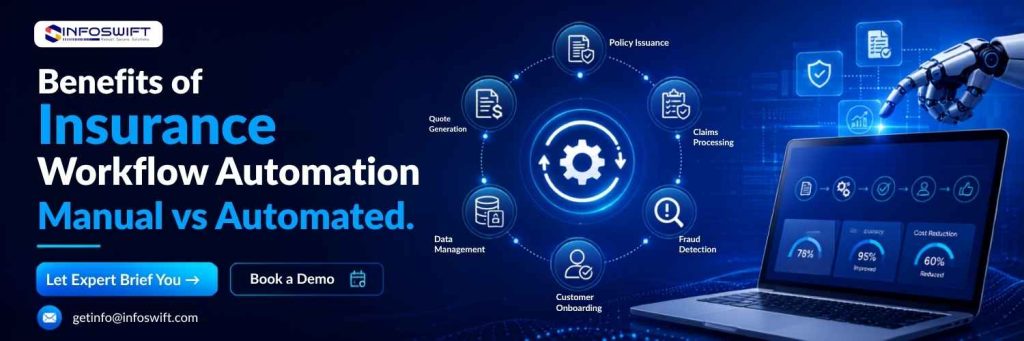
Benefits of Insurance Workflow Automation: Manual vs Automated
The shift from manual to automated insurance processes is measurable at every stage of the policy lifecycle. The table below reflects outcomes from production deployments across insurance operations.
Manual Process | Automated Process |
Slow policy approvals hours to days | Instant workflow triggers decisions in minutes |
Manual data entry at every handoff | Automated data capture, extraction, and routing |
Human errors: 1–4% on data entry tasks | AI-assisted accuracy: 95%+ on validated workflows |
Higher per-transaction operational costs | Lower cost per policy as volume scales |
Claims delayed by document backlogs | Faster claims settlement with AI triage and STP |
Limited scalability without hiring | High scalability volume increases without headcount |
Inconsistent compliance documentation | Automated audit trail on every transaction |
Manual renewal tracking and follow-up | Proactive renewal automation with zero leakage |
AI vs Traditional Insurance Automation Understanding the Difference
Not all insurance automation is equal. Understanding the distinction helps evaluate which approach or which combination fits your operation.
Traditional Automation | AI-Powered Insurance Automation |
Rule-based — fixed logic only | Intelligent decisions based on learned patterns |
Static workflows — manual updates | Self-learning — adapts as data and rules evolve |
Cannot handle unstructured data | Reads documents, emails, images, and free text |
Limited flexibility outside defined rules | Adaptive — handles edge cases and new scenarios |
Breaks when inputs vary from template | Generalises to new document formats and inputs |
No feedback loop for improvement | Continuous improvement from every transaction |
The strongest insurance automation platforms combine both traditional automation for high-volume, structured tasks where rules-based logic is sufficient, and AI where variability, unstructured inputs, or intelligent decision-making is required.
Insurance Agency Automation: What Agencies Can Automate Today
Insurance agency automation addresses the specific operational challenges of agents and brokers smaller teams, high client volumes, and reliance on multiple carrier systems and CRMs.
Lead management: Incoming leads are automatically captured, scored, and assigned to the right agent based on product type and territory eliminating manual CRM entry.
- Customer onboarding: New client document collection, ID verification, and welcome communication workflows are automated from first contact through policy binding.
- Follow-ups and nurturing: Automated email and SMS sequences for outstanding documents, pending applications, and renewal windows triggered by policy dates without manual tracking.
- Renewals: Renewal offers generated and sent automatically based on expiring policy data. Agent is notified only when client response requires intervention.
- CRM integration: Policy data, client communications, and claim updates synchronise automatically between the agency management system and carrier portals no dual data entry.
Real-World Insurance Automation Use Cases by Line of Business
Insurance process automation applies across every line of business. The specific workflows, document types, and compliance requirements vary but the automation layer is consistent.
Auto Insurance | Health Insurance | Home Insurance | Commercial Insurance |
|
|
|
|
Choosing the Right Insurance Automation Software Vendor Checklist
Use this checklist when evaluating insurance automation software vendors. Every item is a production requirement for an insurance operation at scale.
Insurance Automation Software Evaluation Checklist
✔ AI-powered workflow engine — handles structured and unstructured insurance data
✔ RPA capabilities — bot deployment for repetitive data entry, processing, and routing tasks
✔ API integrations — CRM, policy management, payment gateway, email, SMS, and ERP
✔ Cloud deployment — scalable, secure cloud infrastructure with enterprise SLA
✔ Scalable architecture — no volume ceiling, pricing that scales with usage not headcount
✔ Compliance-ready — regulatory validation by jurisdiction and product line, updatable without redevelopment
✔ Security standards — data encryption, SOC 2 alignment, role-based access, full audit logging
✔ Analytics dashboard — real-time KPIs, cycle time monitoring, automation coverage reporting
✔ Low-code workflow builder — operations teams can modify workflows without developer involvement
✔ Mobile accessibility — claims intake, approvals, and status access from mobile for field staff
Why Choose InfoSwift for Insurance Workflow Automation?
InfoSwift is an enterprise AI and digital transformation partner with deep expertise in insurance automation software and RPA for insurance. We do not sell off-the-shelf tools. We build custom insurance workflow automation solutions designed around your specific processes, your system stack, and your regulatory environment.
Our insurance automation teams bring domain expertise in policy lifecycle management, claims workflows, underwriting automation, and compliance documentation combined with production-grade AI and RPA engineering capability.
InfoSwift Service | What It Delivers |
Custom Insurance Workflow Automation | End-to-end workflow design and deployment for your specific insurance processes |
AI-Powered Process Automation | ML and NLP models that handle document extraction, classification, and decisioning |
RPA Development for Insurance | Robotic process automation bots for data entry, policy processing, and compliance tasks |
Quote Portal Development | AI-powered quoting systems with instant calculations and CRM integration |
Claims Automation Solutions | FNOL intake, document verification, fraud detection, and settlement workflows |
Policy Management Systems | Issuance, renewal, endorsement, and version control automation |
AI Document Processing | OCR and NLP for policy documents, claims packages, and compliance filings |
API Integration Services | Connects to your CRM, payment gateway, email, SMS, ERP, and legacy systems |
Cloud Migration and Modernisation | Move from legacy systems to cloud-native insurance automation infrastructure |
Enterprise Support and Maintenance | Ongoing model retraining, workflow updates, and 24/7 technical support |
InfoSwift insurance automation solutions are deployed across carriers, MGAs, and agencies handling auto, health, home, commercial, and specialty lines processing millions of transactions annually with measurable improvements in speed, accuracy, and compliance coverage.
Insurance workflow automation uses software technology to connect and execute insurance processes from quote generation to claims settlement without manual intervention at every step. Automated workflows handle data entry, document processing, routing, approvals, notifications, and compliance checks automatically, reducing processing time and operational cost across the policy lifecycle.
RPA for insurance deploys software bots that replicate human actions in digital systems — logging in, extracting data, entering information, validating records, and sending notifications. Insurance RPA bots operate 24/7, log every action for compliance, and handle high-volume repetitive tasks at speeds human teams cannot match.
Insurance process automation triggers automated workflows based on events a new submission, an incoming claim, a renewal date, a compliance deadline. The workflow executes the required steps automatically: extract data, validate against rules, route to the next stage, update systems, and notify stakeholders. AI handles unstructured inputs like documents and free text. RPA handles structured system interactions.
Faster processing (hours to minutes), lower error rates (1–4% manual vs 95%+ AI accuracy), reduced operational cost per policy, unlimited scalability without headcount increases, consistent compliance documentation on every transaction, and full automated audit trails. Claims settlement is accelerated. Renewal leakage is reduced. Underwriting decisions are faster.
Quote generation, policy issuance, underwriting risk assessment, FNOL intake and claims processing, fraud detection, policy renewals, compliance validation, customer support, and agency operations including lead management, onboarding, and CRM updates. Automation applies across every line of business — auto, health, home, commercial, and specialty.
Enterprise insurance automation operates with data encryption in transit and at rest, role-based access control, full audit logging on every transaction, and configurable data residency. InfoSwift deployments are SOC 2-aligned. RPA bots are permissioned at the system level accessing only the data and applications required for each specific workflow.
AI extends automation beyond rule-based tasks to handle unstructured inputs — reading scanned documents, extracting data from handwritten forms, classifying emails, scoring claims for fraud, and making intelligent underwriting recommendations. Unlike traditional automation, AI learns from data, adapts to new scenarios, and improves accuracy continuously as it processes more transactions
Yes. Insurance automation software connects to existing policy management systems, CRMs, claims platforms, payment gateways, email systems, and ERPs via API — without replacing existing infrastructure. InfoSwift provides pre-built connectors for common insurance platforms and custom API development for proprietary systems. No rip-and-replace required