
Data Analytics in Business: Benefits, Types, and Use Cases
Key Takeaways
- Data analytics helps businesses turn raw data into clear decisions.
- The four main types of data analytics are descriptive, diagnostic, predictive, and prescriptive.
- Businesses use data analytics to improve marketing, sales, operations, finance, and customer experience.
- Data-driven decision making helps companies reduce guesswork and improve performance.
- Companies that use data analytics effectively can identify opportunities faster and respond more confidently.
Monetization
Data analytics in business is no longer limited to large enterprises or technical teams. Today, businesses of all sizes use data analytics to improve decision-making, understand performance, and identify growth opportunities. From customer behavior and sales forecasting to operational efficiency and financial planning, data analytics helps companies move from assumptions to evidence-based action.
Many businesses already collect massive amounts of data, but collecting data alone does not create value. The real advantage comes from analyzing that data, understanding patterns, and using those insights to make smarter decisions. That is why data analytics has become a central part of modern business strategy.
In this blog, you will learn what data analytics is, the main types of data analytics, the key benefits of data analytics for businesses, and real-world examples of how companies are using analytics to transform the way they work.
What Is Data Analytics?
Data analytics is the process of collecting, organizing, analyzing, and interpreting data to find useful insights. These insights help businesses understand what is happening, why it is happening, what may happen next, and what actions should be taken.
In simple terms, data analytics helps answer business questions such as:
- What is driving growth? (OR) what is blocking the business?
- Why are sales dropping? (or) which product or service is picking up the sales?
- Which customers are most likely to leave? (or) which customers are repeat buyers.
- Where are operational delays happening? (or) Operational improvisations are required?
- Which decisions will improve performance?
Without data analytics, businesses often depend too much on instinct or delayed reports. With data analytics, they can make decisions based on facts, patterns, and measurable outcomes.
Why Data Analytics Matters in Business
Data analytics matters because modern businesses need more than information. They need clarity.
A business may think low conversion is caused by pricing, while the real issue is poor user experience. A company may assume a campaign is performing well because traffic is high, while data shows the leads are low quality. A leadership team may believe operations are efficient, while analytics reveals hidden delays and waste.
This is where data-driven decision making becomes valuable. Data analytics helps businesses replace guesswork with evidence. It gives leaders and teams a stronger understanding of performance, customer behavior, operational gaps, and future opportunities.
For companies trying to grow in competitive markets, that level of clarity can make a major difference.
Types of Data Analytics
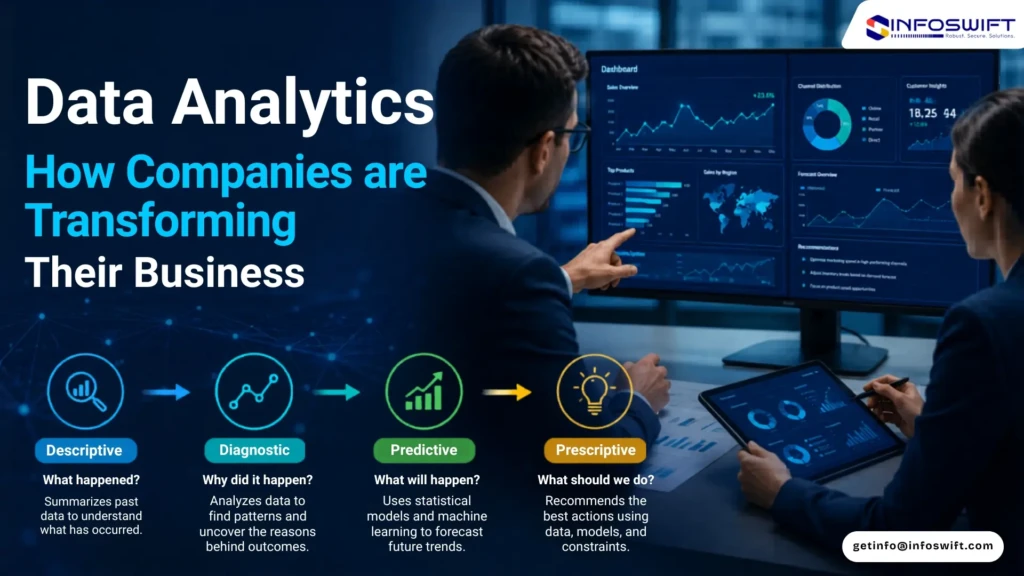
Understanding the different types of data analytics is important because each type supports a different stage of business decision-making.
Descriptive Analytics
Descriptive analytics explains what has already happened.
This is the most common type of data analytics and is often used in dashboards, monthly reports, KPIs, and performance summaries. It helps businesses understand historical outcomes.
Examples of descriptive analytics include:
- Monthly sales reports
- Website traffic summaries
- Customer support volume reports
- Revenue dashboards
- Product performance reviews
Descriptive analytics gives businesses a clear view of past and current performance.
Diagnostic Analytics
Diagnostic analytics explains why something happened.
It goes deeper than reporting and helps businesses uncover reasons behind a trend, issue, or result. This type of analysis is useful when companies want to understand what caused a change in performance.
Examples of diagnostic analytics include:
- Why customer churn increased
- Why one region underperformed
- Why marketing conversions dropped
- Why service complaints rose
- Why operational costs increased
Diagnostic analytics helps businesses move from observation to understanding.
Predictive Analytics
Predictive analytics focuses on what is likely to happen next.
It uses historical data, trends, and statistical modeling to forecast future outcomes. This helps businesses prepare for risk, demand, and growth opportunities more effectively.
Examples of predictive analytics include:
- Forecasting future sales
- Predicting customer churn
- Estimating demand changes
- Identifying leads likely to convert
- Planning inventory needs
Predictive analytics helps companies become more proactive.
Prescriptive Analytics
Prescriptive analytics focuses on what a business should do next.
This is the most advanced type of data analytics because it recommends actions based on likely outcomes. It helps businesses choose the best path forward.
Examples of prescriptive analytics include:
- Recommending pricing changes
- Optimizing marketing budget allocation
- Suggesting the next best sales action
- Improving supply chain decisions
- Adjusting staffing or inventory levels
Prescriptive analytics turns insight into action.
How the Types of Data Analytics Work Together
The types of data analytics are most powerful when used together.
A business may first use descriptive analytics to see that sales declined. Then it may use diagnostic analytics to find out why. Next, predictive analytics can estimate whether that trend will continue. Finally, prescriptive analytics can recommend what action to take.
This is how data analytics moves from basic reporting to strategic decision-making. It helps businesses understand the past, diagnose the present, prepare for the future, and act with more confidence.
Benefits of Data Analytics for Businesses
The benefits of data analytics go far beyond reports and dashboards. When used well, data analytics can improve performance across the entire business.
Better Decision-Making
One of the biggest benefits of data analytics is stronger decision-making. Businesses can make choices based on actual patterns and measurable outcomes instead of relying only on assumptions.
This leads to better planning, fewer costly mistakes, and more confidence in strategy.
Improved Operational Efficiency
Data analytics helps businesses identify inefficiencies, bottlenecks, delays, and wasted effort. It shows where processes are slowing down and where resources can be used better.
That makes it easier to improve workflows and reduce unnecessary costs.
Stronger Customer Insights
Businesses use data analytics to understand customer behavior, buying patterns, churn signals, preferences, and engagement trends. These insights support better retention, stronger communication, and more effective customer experiences.
Smarter Forecasting
Forecasting becomes more reliable when it is based on historical performance and data trends. Businesses can use data analytics to estimate demand, revenue, staffing needs, inventory levels, and future growth opportunities.
Faster Problem Detection
Data analytics helps companies spot issues earlier. Instead of waiting until a problem becomes obvious, businesses can identify warning signs through performance data and act sooner.
Competitive Advantage
Companies that use data analytics effectively can respond faster to changes, identify opportunities earlier, and improve performance more consistently than competitors that rely on assumptions alone.
Data Analytics Use Cases in Business
Data analytics use cases can be found across nearly every business function. The real value of analytics appears when businesses apply it to practical challenges.
Marketing Analytics
Marketing teams use data analytics to track campaign performance, lead quality, customer acquisition trends, and channel ROI.
This helps businesses answer questions such as:
- Which campaigns drive the best leads?
- Which channels convert most effectively?
- Which messages improve engagement?
- Where is ad spend being wasted?
Marketing analytics helps businesses make smarter budget and strategy decisions.
Sales Analytics
Sales teams use data analytics to track conversion trends, pipeline health, sales velocity, and performance by region, product, or segment.
This makes it easier to forecast revenue, improve targeting, and identify stronger growth opportunities.
Customer Analytics
Customer analytics helps businesses understand buying behavior, retention patterns, churn risk, usage trends, and service issues.
These insights support better customer experience, stronger loyalty, and more effective retention strategies.
Operational Analytics
Operational analytics helps businesses understand workflow efficiency, turnaround times, bottlenecks, and process gaps.
For example, a company may discover that one approval step delays fulfillment or that one team is overloaded while another is underused.
Financial Analytics
Finance teams use analytics to monitor spending, profitability, margins, budget performance, and cost trends. This helps businesses make more informed financial decisions and improve resource allocation.
Customer Support Analytics
Support teams use data analytics to monitor ticket trends, issue categories, response times, satisfaction scores, and escalation patterns. This helps businesses improve service quality and identify deeper product or process issues.
Real-World Examples of Data Analytics in Companies
Real-world examples of data analytics in companies often show up in day-to-day business decisions.
A retailer may use predictive analytics to estimate inventory demand before peak seasons.
A SaaS company may analyze customer usage data to identify churn risks.
A logistics business may use operational analytics to improve delivery efficiency.
A marketing team may use campaign data to refine targeting and improve conversion rates.
A finance team may track margin performance to identify underperforming business units.
These analytics in business examples show that transformation does not always come from one big system change. It often starts with better visibility into what the data is already showing or lying.
How Companies Are Transforming Their Business With Data Analytics
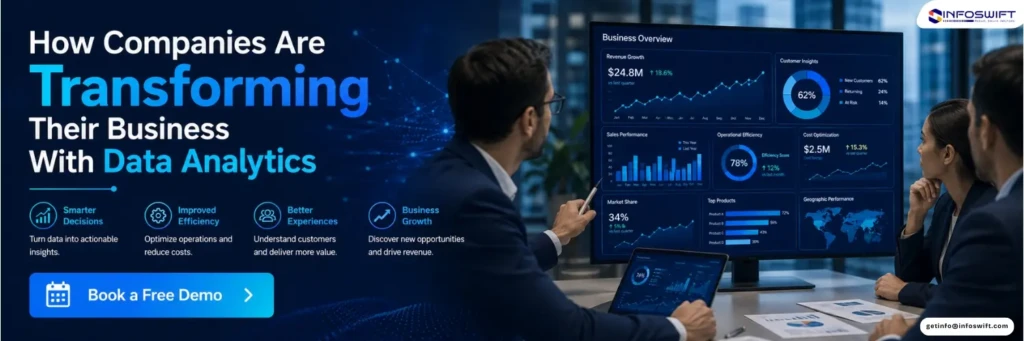
Companies are transforming their business with data analytics by making data part of how they operate, not just how they report.
This transformation usually includes:
- Better visibility into performance
- Faster identification of problems
- Stronger forecasting and planning
- More accurate customer insights
- Improved efficiency across teams
- Better resource allocation
- More evidence-based decisions
When data analytics becomes part of daily decision-making, businesses move from reacting late to responding early. That shift improves performance, agility, and long-term growth.
Common Data Analytics Mistakes Businesses Make
Even though the value of data analytics is clear, many businesses still struggle to use it effectively.
Collecting Too Much Data Without Clear Goals
Businesses often gather large amounts of data without deciding which questions they need answered. This creates noise instead of insight.
Focusing Only on Reports
Reports are useful, but reporting alone is not enough. Data analytics only creates value when insights lead to action.
Ignoring Data Quality
Poor data quality leads to poor decisions. If data is incomplete, outdated, or inconsistent, the analysis becomes less reliable.
Working With Disconnected Data Sources
When business data is spread across disconnected systems, analytics becomes harder to trust and harder to use effectively.
Treating Analytics as Only a Technical Task
Data analytics should support business teams, not just technical teams. Leaders, marketers, operations teams, finance teams, and sales teams all benefit from better analytics.
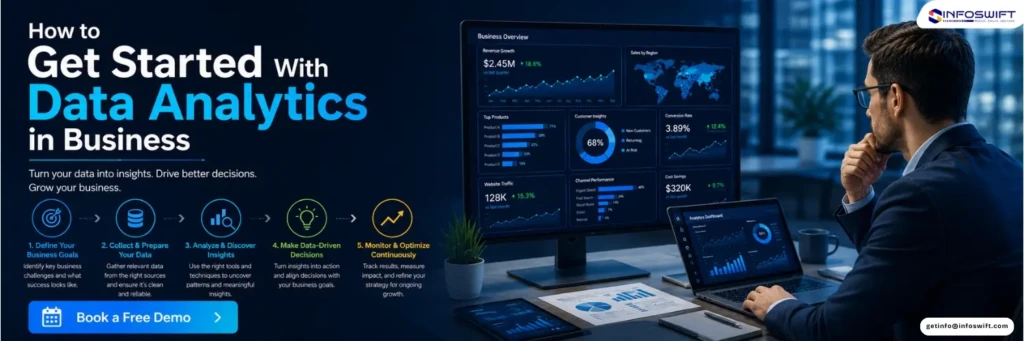
How to Get Started With Data Analytics in Business
Businesses do not need to become advanced overnight. The best way to get started with data analytics is to begin with business priorities.
Start With Business Questions
Focus on the decisions that matter most. This could include improving customer retention, forecasting sales, reducing operational waste, or improving campaign performance.
Review Available Data
Understand what data already exists, where it lives, and whether it is reliable enough to support decision-making.
Define Useful Metrics
Choose metrics that connect directly to business performance. Clear metrics make analytics more actionable.
Improve Visibility First
Before moving into advanced predictive models, many businesses benefit from stronger reporting, cleaner dashboards, and better operational visibility.
Build Toward Advanced Analytics
Once the basics are working well, businesses can move into diagnostic, predictive, and prescriptive analytics with more confidence.
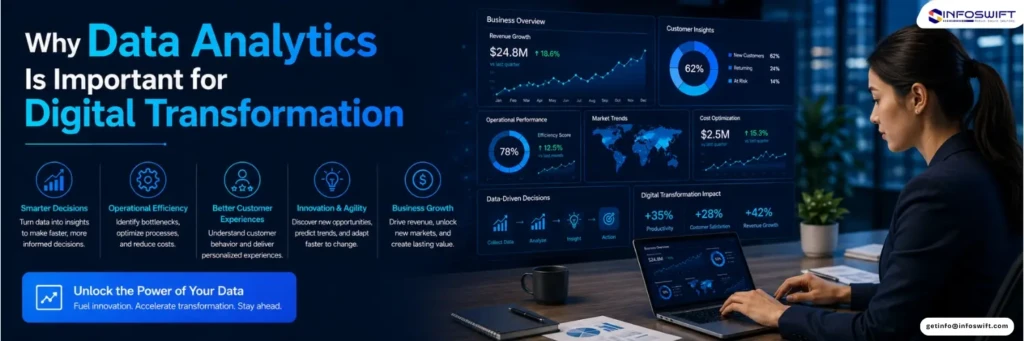
Why Data Analytics Is Important for Digital Transformation
Digital transformation is not just about technology adoption. It is about improving how a business works, decides, and grows.
Data analytics is a key part of digital transformation because it gives businesses the visibility needed to improve systems, customer experiences, workflows, and strategy. Without analytics, digital transformation often becomes surface-level change. With analytics, it becomes measurable and easier to improve.
How InfoSwift Can Help Businesses Become More Data-Driven
Businesses often need more than dashboards. They need stronger workflows, smoother integration, better data movement, and systems that support better decisions.
InfoSwift helps businesses streamline operations through automation, system integration, workflow optimization, and scalable technology solutions that build a strong foundation for data-driven growth. By aligning systems, processes, and data flows, businesses can unlock more accurate analytics, improve decision-making, and respond to insights with greater efficiency and confidence.
With extensive experience supporting large enterprises, mid-sized organizations, and startups handling high transaction volumes, InfoSwift has successfully delivered solutions that improve operational performance, enhance productivity, and support long-term digital transformation goals.
Conclusion
Data analytics in business helps companies move from uncertainty to clarity.
It explains what is happening, why it is happening, what may happen next, and what actions should follow. That makes data analytics valuable across marketing, sales, customer experience, operations, finance, and strategy.
The businesses getting the most value from data analytics are not just collecting numbers. They are using those numbers to improve decisions, solve problems faster, understand customers better, and create stronger business performance.
For modern companies, data analytics is not just a support function. It is a competitive advantage.
FAQ’s
Data analytics in business is the process of analyzing business data to find insights that improve decision-making, efficiency, and performance.
The main types of data analytics are descriptive, diagnostic, predictive, and prescriptive analytics.
Data analytics benefits businesses by improving decision-making, operational efficiency, customer understanding, forecasting, and overall performance.
Companies use data analytics for marketing analysis, customer behavior insights, sales forecasting, operational improvement, financial tracking, and support optimization.
Data-driven decision making helps businesses make more accurate and confident choices based on facts instead of assumptions.
Common use cases include campaign analysis, churn prediction, demand forecasting, workflow optimization, financial monitoring, and customer support analysis.